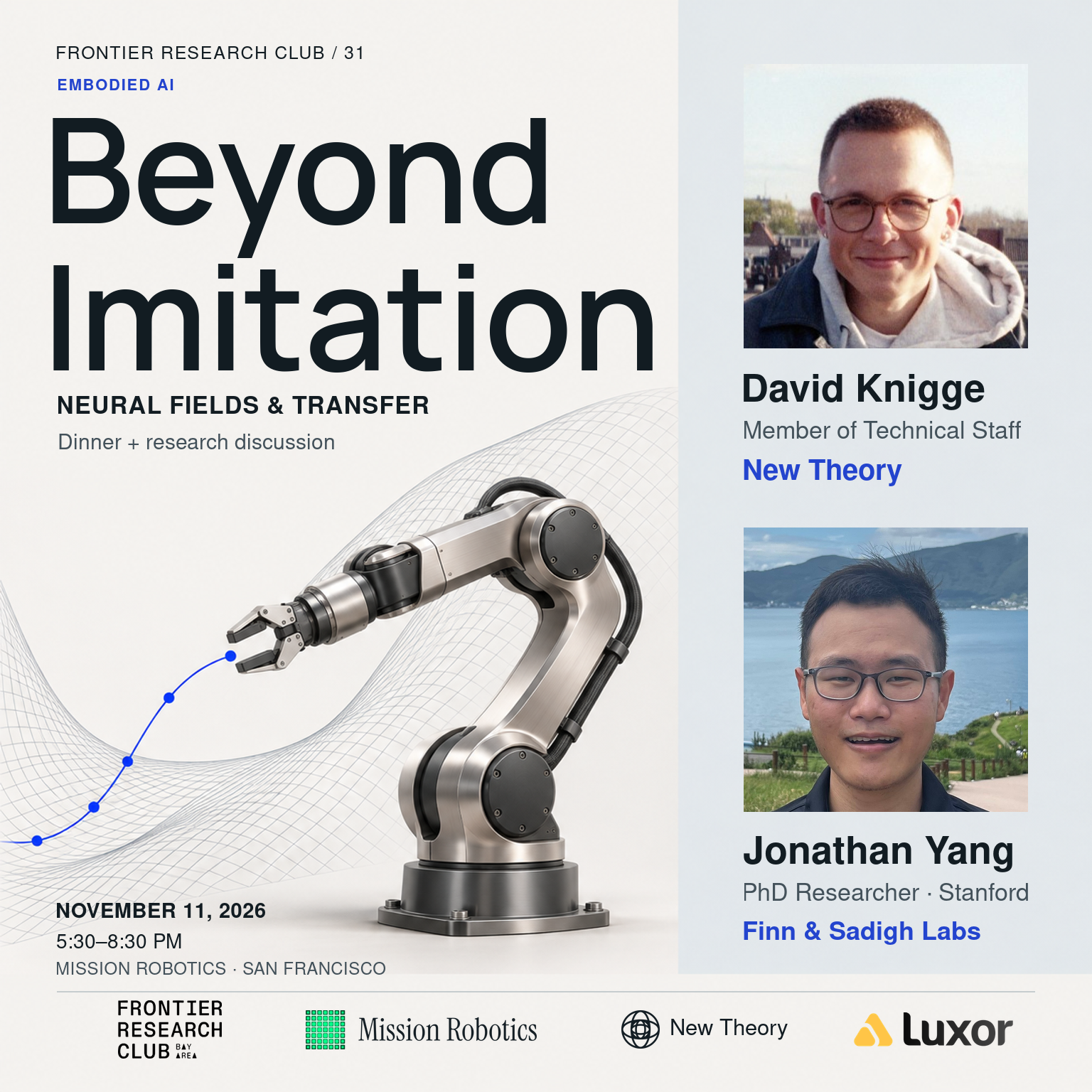
The robotics research crowd is back at Mission Robotics.
The Embodied AI track is a monthly research forum co-hosted with New Theory at Mission Robotics, an 8,500 sq ft brick-and-timber robotics facility in the heart of the Mission — a floor shared with more than a dozen robots.
Most robot learning today starts from human demonstrations: collect enough examples and train a policy to imitate them. Talk 1 comes from the builder's seat — what neural fields can bring to robot learning, treating actions as continuous signals rather than fixed-rate grids. Talk 2 comes from a different direction: generalist policies usually assume one controller per robot, but the same action can mean different things under different controllers. The work shows how a policy can adapt in context from commanded-versus-achieved interaction history, instead of pooling demonstrations as if the controllers were the same. Expect the room to push on what each approach buys, and where it breaks.
The Frontier Research Club is a curated forum for rigorous, technical discussion at the frontier of AI. We convene researchers from the frontier labs, Stanford, Berkeley, and the teams building in production to examine concrete work — papers, methods, and results — with a bias toward assumptions, evaluation methodology, failure modes, and what would count as convincing evidence.
Presentations are intentionally brief so the majority of time is reserved for questions and critique. Materials are shared in advance so the conversation starts at depth.
Agenda
5:30pm: Doors open5:30pm – 6:30pm: Networking + light dinner6:30pm – 8:00pm: Research presentations + discussion8:00pm – 8:30pm: Networking
Presenters & topics
Talk 1 – David Knigge, New Theory (Member of Technical Staff)
Actions as Fields: neural fields from signal representation to robot control
Most of the data we learn from, like images, 3D shapes and physical simulations, is a continuous signal that we happen to store on a grid. Most deep learning architectures are tied to these fixed-rate grids. Neural Fields provide a way of learning continuous functions for the underlying data, that can then be used as representations in downstream tasks, creating a learning framework that is agnostic to sampling resolution, grid regularity and dimensionality of the input data. David gives a quick primer on the lineage of Neural Fields as learnable representations, including work on equivariant neural fields, which give a field’s latent space a notion of geometry and locality. Then, he turns to robot actions, which also happen to be a signal in time.
Talk 2 — Jonathan Yang, Stanford
Cross-Controller Transfer via In-Context Behavior Adaptation
Generalist policies usually assume one controller per robot, but the same commanded action can mean different things under different controllers. This work shows a policy can adapt in context from the history of what was commanded versus what the robot actually did, rather than pooling demonstrations as if the controllers were interchangeable. Results include large lifts over naive pooling, including on unseen controller modes and gains, and on contact-rich tasks like USB insertion and surface wiping, where the strategy itself changes with compliance.
Pre-read: Cross-Controller Transfer via In-Context Behavior Adaptation — Jonathan Yang, Chelsea Finn, Dorsa Sadigh (arXiv). Project page: controller-transfer.github.io.
Want to present your work?
If you have a research paper you'd like to discuss at one of our next sessions, please submit it for consideration.
Submit your paper here!
Who should attend
-
Robotics researchers and research engineers
-
People training or deploying policies on real hardware — manipulation, humanoids, VLA, sim-to-real, world models
-
People building imitation learning pipelines — teleoperation, demonstration data, behavior cloning, and the policies trained on them
-
People working on neural fields, continuous representations, or equivariant models for control
-
Researchers working on cross-embodiment or cross-controller transfer, in-context adaptation, and contact-rich manipulation
-
Founders and engineers building tooling for robot data, simulation, and evaluation
Capacity is limited.
We will take photos and short video clips for event recap and promotion. By attending, you consent to being photographed and recorded, and to the use of those images and clips by the organizers on social media and other event marketing channels.
🌐 Connect with Frontier Research Club
Hosted by
Frontier Syndicate is a venture community connecting frontier tech researchers, builders, and investors through curated convenings and early-stage capital. Across the Bay Area, we host a recurring series of research forums, builder nights, and intimate investor dinners — and back exceptional companies emerging from the labs, communities, and technical networks we convene.
Mission Robotics is 8,500 square feet in the heart of the Mission — a converted brick-and-timber factory, hardwired for hardware, where founders at the frontier of embodied AI build alongside more than a dozen robots. Home to humanoids, robot arms, a shared data-collection rig, and a frontier world model on tap, it's purpose-built for the people teaching machines to act in the physical world.
Sponsored by
New Theory is a San Francisco research company building foundation models for robotics, rooted in geometric deep learning, with the aim of making robots more efficient, explainable, and general than transformer scaling alone allows. New Theory co-hosts the Embodied AI track with Frontier Research Club at Mission Robotics.
Luxor Agent Cloud is cloud infrastructure for your code and your AI agents. It gives agents Linux sandboxes that start in under a second, GitHub Actions runners that cost half GitHub’s price and run up to 3x faster, and AI code review that flags only the issues that should block a merge. All three plug into your existing GitHub setup in about two minutes.