Description
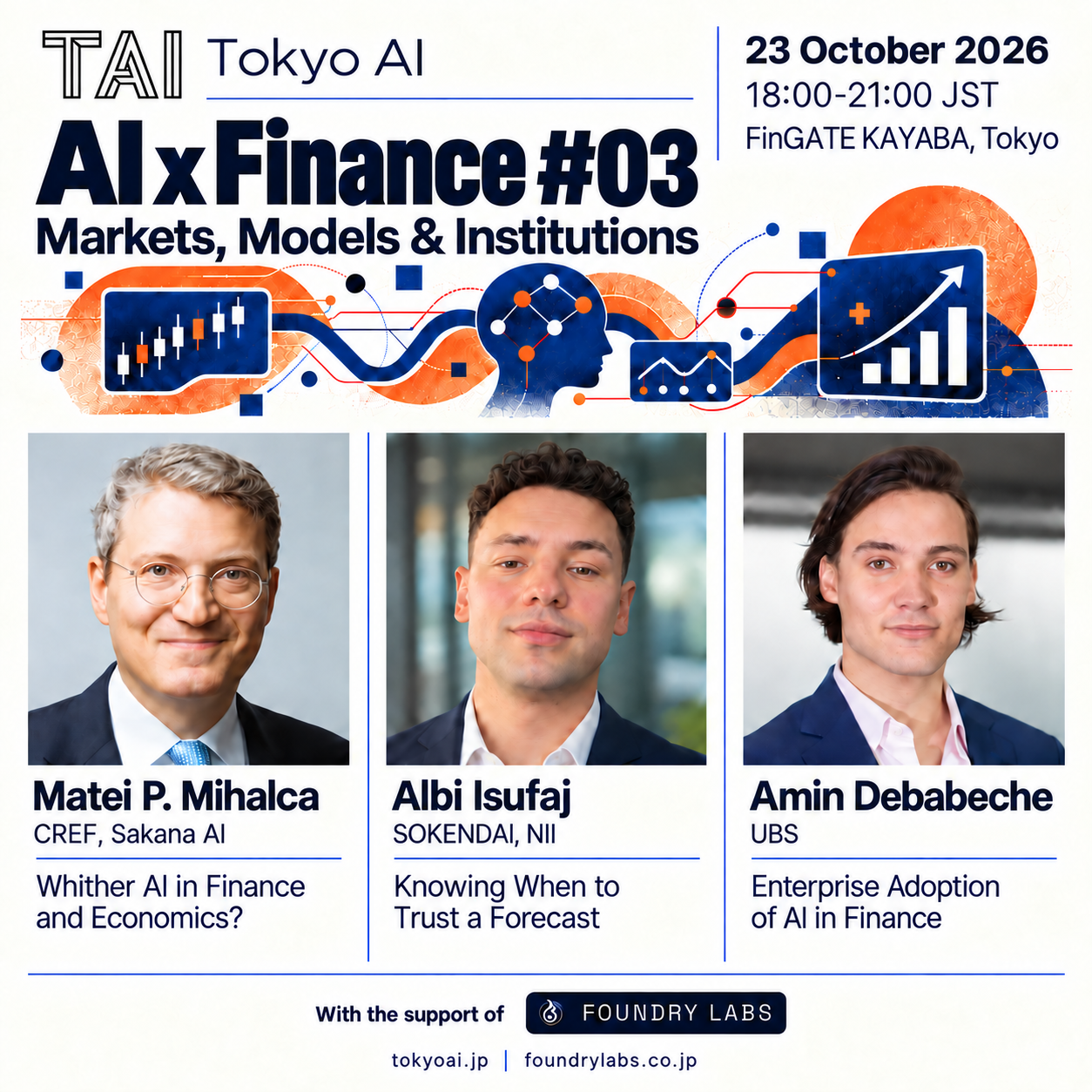
An evening on AI in finance and economics, moving from complex-systems thinking about markets and investment to trustworthy financial forecasting and the realities of enterprise deployment. Matei P. Mihalca, Albi Isufaj and Amin Debabeche will speak.
Agenda
18:00 Doors open
18:30-19:00 - Talk 1: Whither AI in Finance and Economics? (Matei P. Mihalca)
19:00-19:30 - Talk 2: Knowing When to Trust a Forecast (Albi Isufaj)
19:30-20:00 - Talk 3: Enterprise Adoption of AI in Finance (Amin Debabeche)
20:00-21:00 Networking
21:00 Doors close
Talks
Talk 1: Whither AI in Finance and Economics?
Speaker: Matei P. Mihalca (CREF, Sakana AI)
Abstract: We’ll review what might be considered stages in the development of AI applied to finance and economics, what each stage accomplished, and the direction in which we are going. We’ll argue that the rise of AI is changing what is possible in economic understanding but the guidance of a worldview is required to make the most of that potential. Complex systems offer such a worldview. AI’s successful future use in investment is arguably premised on the integration of human insights in an industrial, automated process at scale – grounded in ontology that’s not only operational platform but epistemological foundation. The computational study of technological innovation and the capture of its economic value through investment will be presented as a case study.
Bio: Matei P. Mihalca is Advisor to Sakana AI and an affiliated researcher at the Centro Ricerche Enrico Fermi in Rome, where he works on complexity economics and the computational study of innovation. Matei’s career spans Goldman Sachs Asset Management, AQR, Merrill Lynch, Macquarie, and CITIC Capital, and he co-founded Forward Partners. Matei earned an MA and pursued doctoral studies at Harvard University, and earlier studied in Beijing, China, as well as in his native Romania. Matei was named a Young Asian Leader by the World Economic Forum in 2003.
Talk 2: Knowing When to Trust a Forecast: Reliability Learning for Financial Time Series
Speaker: Albi Isufaj (SOKENDAI, NII)
Abstract: Most forecasting models answer every question they are asked, even when they have no real edge. In markets, that is costly: a model that acts only when it has a reason to be confident can be far more useful than one that is marginally right every day. In this talk, I present a two-stage architecture that separates what to predict from when to trust the prediction. A time-series foundation model produces directional forecasts, and a second, learned reliability layer decides which of them are worth acting on. I'll walk through how the system is built, how we turn the question of when to act into a risk–coverage optimization, and what we can and can't conclude from the backtests.
Bio: Albi Isufaj is a PhD candidate in Informatics at SOKENDAI and the National Institute of Informatics (NII) in Tokyo, in Prof. Helmut Prendinger's lab. His research focuses on AI for finance, specifically on making machine-learning forecasts for financial markets more reliable. Along the way, he works on time-series foundation models, causal discovery in financial markets, neuro-symbolic AI and conformal prediction. Before coming to Japan, he studied Industrial and Applied Mathematics in University of Grenoble Alpes (ENSIMAG), France and Mathematics in Faculty of Natural Science, University of Tirana, Albania.
Talk 3: Enterprise Adoption of AI in Finance
Speaker: Amin Debabeche (UBS)
Abstract: Financial institutions have moved past the pilot stage with AI, and generative and agentic systems are now running in production in front-, middle-, and back-office workflows. This talk surveys the current landscape and looks at where AI delivers measurable value today: trading and execution, risk and fraud detection, compliance and KYC automation, research and document intelligence, and client-facing operations. For a few areas, we'll look at what separates successful deployments from stalled experiments, including data infrastructure, model governance, latency and reliability constraints, and the regulatory expectations specific to finance.
Bio: Amin Debabeche is a FDE at UBS Tokyo, where he builds custom classical and agent-led solutions for the local Asset Management business. A computational chemist by training, he conducted research at IBM Research Europe and MIT before transitioning into finance. In Switzerland, he held multiple software development and data science roles at UBS in Zurich, and drove the full digital transformation of a hedge fund management firm's technology stack and operational processes.
Organizers
Ilya Kulyatin is an entrepreneur with work and academic experience in the US, Netherlands, Singapore, UK, and Japan. He holds a BA in Economics, an MA in Finance, and an MSc in Machine Learning. He's a 3x founder, now helping Japan grow the local AI ecosystem through a not-for-profit community, Tokyo AI (TAI), while building an AI-native system integrator and solutions provider, Foundry Labs株式会社.
Supporters
Foundry Labs K.K. is a Tokyo-based AI systems integrator and solutions provider, delivering end-to-end support for enterprises: from strategy design through implementation, deployment, and operations. They tailor AI to each client's operational, regulatory, and security requirements, with hands-on experience across finance, government, and industry, and a track record of shipping production systems in secure and regulated environments.
Aurora Solutions K.K. is a specialist consulting firm in CCP clearing, Collateral and Risk Management, Digital Regulatory Reporting (DRR), DLT, and Generative AI for financial institutions. They partner with banks, clearing houses, and market infrastructures to deliver end-to-end solutions, from idea to production, helping their clients navigate complex regulations, modernise legacy platforms, and harness emerging technologies to accelerate the delivery of innovative services.
About TAI
Tokyo AI (TAI) is the largest international AI community in Japan, with 5,000+ members mainly based in Tokyo: engineers, researchers, investors, product managers, and corporate innovation leaders. Through 80+ events a year and 300+ speakers spanning startups, enterprises, and academia, TAI connects the people building AI in Japan with the global ecosystem, working to transform Tokyo into a global AI hub.
Privacy Policy
We will process your email address for the purposes of event-related communications and ongoing newsletter communications. You may unsubscribe from the newsletter at any time. Further details on how we process personal data are available in our Privacy Policy.