About this event
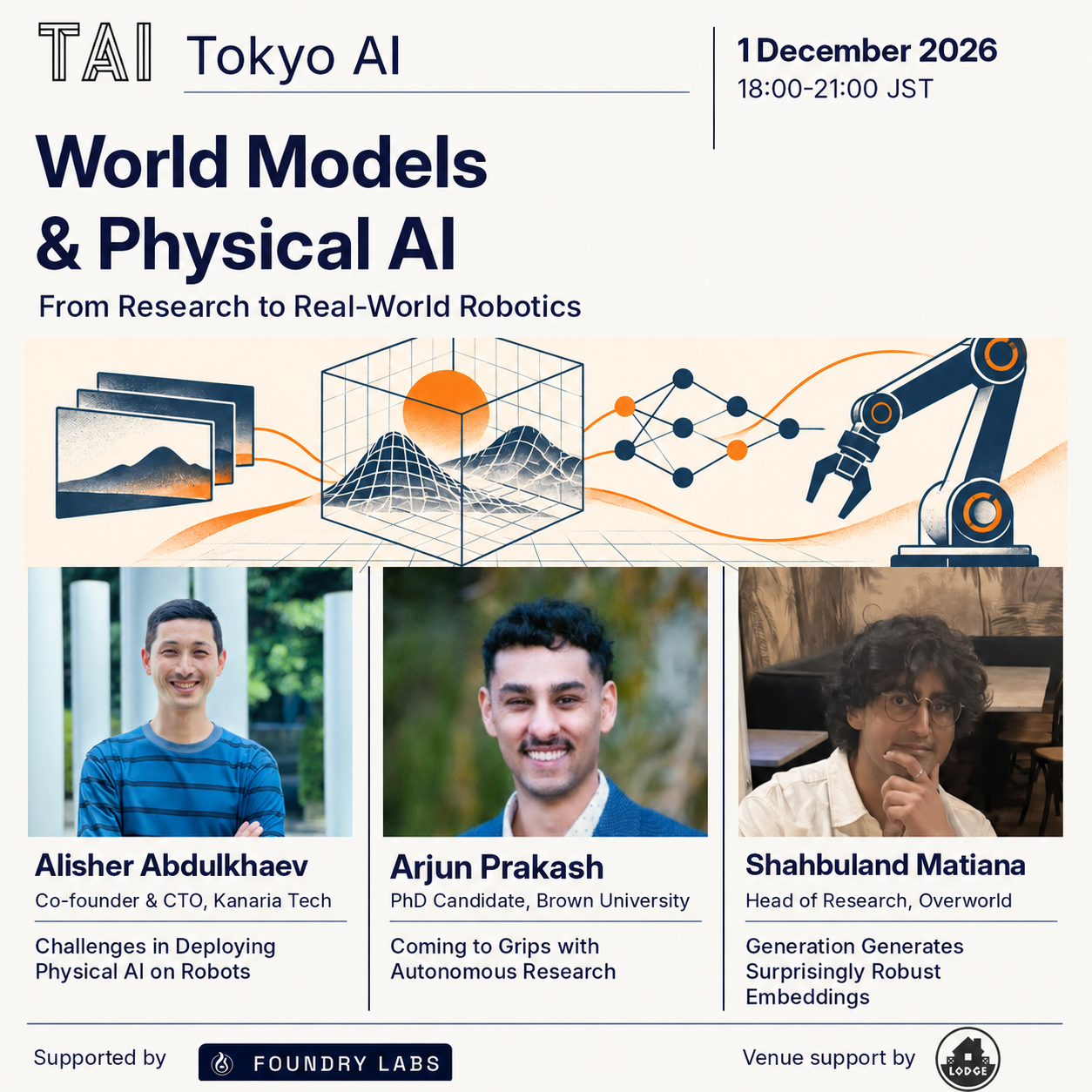
How do you make learned models work on robots that must respond quickly and move safely around people? Join Tokyo AI (TAI) and speakers from Kanaria Tech, Brown University and Overworld for an evening covering robot deployment, autonomous research and the representations learned by generative models.
We'll explore:
-
Robot navigation in practice: how Kanaria's three-layer KRM stack addresses latency, model errors and differences between robots and deployment sites.
-
AI agents doing research: findings from the Autonomous Machine Learning Workshop at NeurIPS, plus experiments using agents to speed up robotics model inference on unconventional hardware.
-
Generative models as world encoders: why architectures built for generation also produce useful embeddings, what those embeddings capture and how they can support downstream tasks.
Bring your questions on robotics, reinforcement learning, inference and representation learning. Each talk includes Q&A, followed by an hour of discussion and networking.
When: Tuesday, December 1, 2026, 18:00-21:00 JSTWhere: Tokyo, venue TBALanguage: English
Agenda
-
18:00-18:30 - Doors open and networking
-
18:30-19:00 - Talk 1: Challenges in Deploying Physical AI on Robots (Alisher Abdulkhaev)
-
19:00-19:30 - Talk 2: Coming to Grips with Autonomous Research (Arjun Prakash)
-
19:30-20:00 - Talk 3: Generation Generates Surprisingly Robust Embeddings (Shahbuland Matiana)
-
20:00-21:00 - Discussion and networking
Talks and speakers
Talk 1: Challenges in Deploying Physical AI on Robots
Alisher Abdulkhaev, Co-founder & CTO, Kanaria Tech
World models and vision-language-action models can look convincing in demos. Real-world deployment is a different problem. Learned models must deal with latency, errors, and the safety requirements of robots operating around people, while hardware and environments vary from one site to another.
Alisher will walk through KRM, Kanaria's three-layer robot navigation stack, and explain the deployment problem each layer is designed to solve.
About Alisher: Alisher is co-founder and CTO of Kanaria Tech, a Tokyo-based robotics startup. Previously, he led AI and data science at ROMS and worked on computer vision at PKSHA Technology and Rakuten. He conducted PhD research on video action recognition at the University of Tsukuba and served as a board director of Machine Learning Tokyo.
Talk 2: Coming to Grips with Autonomous Research
Arjun Prakash, PhD Candidate, Brown University; Summer Robotics Researcher, Overworld
Autonomous AI agents are beginning to contribute to the research process itself. Arjun will share preliminary findings from the Autonomous Machine Learning Workshop at NeurIPS, including research in which an autonomous agent made a decisive contribution to the paper's main result.
He will also discuss his own work applying autonomous research to robotics, including the use of agents to substantially accelerate model inference on unconventional hardware.
About Arjun: Arjun is a PhD candidate in computer science at Brown University, researching reinforcement learning and robotics. His work examines how neural networks can continue training for robotic control in changing environments, with a recent focus on autonomous research.
Talk 3: Generation Generates Surprisingly Robust Embeddings
Shahbuland Matiana, Head of Research, Overworld
What does a generative model learn about the world along the way? Recent generative architectures offer major speed improvements for video generation and can also produce strong embeddings as a byproduct.
Shahbuland will explore why this happens, what these embeddings actually represent, and how they can support downstream tasks. He will cover limitations of current embedding and video-generation models, potential applications for a general world encoder, and the research still needed.
About Shahbuland: Shahbuland leads research into real-time video world models at Overworld. Previously, he worked on diffusion models, reinforcement learning, and multimodal architectures at Stability AI. He co-founded CarperAI while studying at the University of Waterloo, contributing to open-source work on model alignment, language embeddings, and contrastive learning.
Organizers
Tokyo AI (TAI) connects engineers, researchers, founders, and technical leaders building AI in Japan. Cedric Wagrez will lead the event onsite.
Supporters
Foundry Labs K.K. is a Tokyo-based AI systems integrator and solutions provider, delivering enterprise AI systems from strategy and engineering through deployment and operations.
About TAI
Tokyo AI is an international AI community in Japan with more than 7,000 members, connecting people building AI locally with the global research and technology ecosystem.
Privacy Policy
We will process your email address for event-related communications and ongoing newsletter communications. You may unsubscribe at any time. Further details are available in our Privacy Policy.