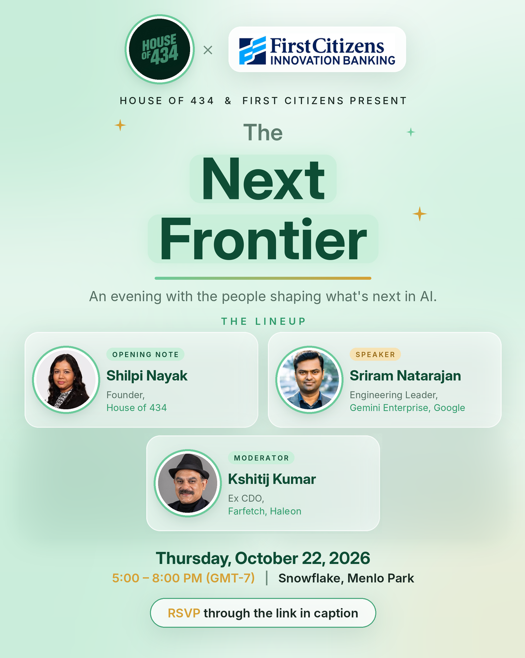
The Next Frontier
An Evening with the People Shaping What's Next in AI
A private House of 434 gathering at Snowflake, Menlo Park
We are entering a new chapter of artificial intelligence.
In just a few years, AI has moved from generating text and images to writing software, solving increasingly complex problems, conducting research, and carrying out work that once required teams of people.
Yet for all the progress, some of the most consequential questions remain unanswered.
Are today's architectures sufficient to take us to the next level of intelligence? What comes after the current generation of large language models? How much autonomy can we safely give AI systems? What happens when intelligence becomes abundant, but compute, energy, data, and trust remain scarce?
And perhaps most importantly, what becomes possible to build now that wasn't possible before?
The Next Frontier brings together researchers, founders, engineering leaders, and investors at the forefront of AI for an evening of candid conversations about where the field is heading.
We will explore the breakthroughs happening inside leading AI labs, the systems bringing those capabilities into the world, the technical and economic constraints that could shape the next decade, and the opportunities emerging for founders.
This isn't a discussion about the latest product announcements or incremental improvements to existing tools.
It's about the deeper shifts in intelligence, computing, and company creation that could define what comes next.
Speakers:
Selected Founder Pitches: two founders from the community will each give a 3-minute pitch - Kavitha Prasad (Counterrun.ai) and Krystal Gracier (A-Comm.ai).
Sriram NatarajanEngineering Leader, Gemini Enterprise, Google
Sriram works on enterprise AI at Google, tackling complex workflows and the challenges of bringing AI into production. Previously, he was Senior Director of Engineering, Applied AI at GEICO and Co-founder & CTO of Yuni. He brings experience building AI systems and addressing the reliability, governance, and deployment challenges that come with greater autonomy.Additional speakers to be announced.
Moderator:
Kshitij Kumar - Ex-CDO at Farfetch | Chief AI Officer and CEO at Data-Hat AI
Opening Note:
Shilpi Nayak - Founder, House of 434
The Conversation
01 / Beyond Today's Frontier Models
Are we approaching the limits of current approaches, or just beginning to understand their potential?
Scaling has driven extraordinary progress in AI, but the next breakthroughs may require more than larger models and more compute.
We will explore the research directions that could reshape the field, from new reasoning and learning approaches to multimodal intelligence, memory, adaptation, and more efficient architectures.
-
What are the most significant limitations of today's frontier models?
-
Where are additional compute and scale still delivering meaningful gains, and where might new approaches be necessary?
-
Can AI systems learn continuously and adapt to unfamiliar environments?
-
What research directions are underappreciated today but could become foundational over the next five years?
02 / From AI Assistants to Autonomous Systems
What happens when AI stops waiting for instructions and starts carrying out complex work?
AI is moving beyond individual prompts toward systems that plan, use tools, coordinate with other agents, and execute longer sequences of work.
But autonomy introduces new challenges in reliability, verification, safety, cost, and control.
We'll examine what it takes to move from impressive demonstrations to systems capable of operating independently in consequential environments.
-
How close are we to AI systems that can reliably execute complex, multistep tasks?
-
Will multi-agent architectures become fundamental to how software is built, or introduce more complexity than value?
-
What must change in memory, evaluation, orchestration, and oversight?
-
Where should humans remain in control, and where could autonomy fundamentally change how organizations operate?
03 / Intelligence Beyond the Screen
What changes when AI must understand and act in the physical world?
Much of the recent AI revolution has happened in digital environments. The next wave of applications may increasingly involve the world beyond them.
From robotics and industrial automation to scientific laboratories, semiconductor design, energy systems, and advanced manufacturing, AI is beginning to interact with physical processes and infrastructure.
The opportunities are enormous, but so are the challenges.
Physical environments introduce uncertainty, limited data, real-time constraints, safety requirements, and consequences that cannot simply be undone.
-
What will it take to move from digital intelligence to systems that understand and operate in the physical world?
-
Where are foundation models genuinely changing robotics, science, and industrial automation?
-
How important are simulation, world models, and real-world data?
-
Which applications are approaching commercial viability, and which still require major research breakthroughs?
04 / The Infrastructure and Economics of Intelligence
If intelligence becomes abundant, what remains scarce?
The economics of AI are changing rapidly.
Training and inference costs, compute availability, energy consumption, model efficiency, and infrastructure constraints are shaping which technologies can scale and which companies can survive.
As models become more capable and accessible, the competitive advantage may shift toward entirely different parts of the technology stack.
-
Will compute remain the defining bottleneck, or will energy, memory, data, and system efficiency become equally important?
-
How will improvements in inference economics change what developers can build?
-
What happens to differentiation when powerful models become broadly available?
-
Where will enduring value accumulate: models, infrastructure, proprietary data, applications, distribution, or entirely new layers?
05 / The Next Generation of AI Companies
What would you build today if you were starting from zero?
Every major technology shift creates a new generation of companies, but the greatest opportunities are rarely obvious at the beginning.
As AI capabilities advance, existing products, business models, and organizational structures are being reconsidered.
Some opportunities will come from replacing established workflows. Others may create categories that did not previously exist.
We'll bring together the perspectives of researchers, founders, and investors to explore where the most compelling opportunities are emerging.
-
Which problems are newly solvable because of advances in AI?
-
Where is the market underestimating the technical difficulty or overestimating near-term adoption?
-
What will distinguish an enduring AI company from a temporary application built on someone else's models?
-
If you were leaving a frontier AI lab to start a company today, what would you build?
-
What are investors missing about the next generation of AI?
Beyond the Panel
Some of the most interesting conversations happen when the microphones are off.
Following the opening discussion, the evening will transition into smaller, informal conversations across the room.
Rather than assigned tables or structured networking, guests will have the freedom to move between groups, meet speakers, exchange perspectives, and explore the questions that interest them most.
Researchers can exchange ideas with founders translating breakthroughs into products. Engineering leaders can compare what is possible in theory with what works in practice. Investors can hear directly from the people building the underlying technology.
The goal is not to reach a consensus.
It's to bring together people with different experiences and convictions, create space for thoughtful disagreement, and leave with a better understanding of what might come next.
The Evening
5:00 PM | Arrival and Welcome
Drinks, introductions, and an opportunity to meet fellow guests.
5:30 PM | Opening Remarks
Welcome from House of 434 and our hosts.
5:40 PM | The Next Frontier: A Candid Conversation
A focused discussion with leaders across AI research, frontier models, emerging technologies, and company building.
6:20 PM | Conversations Beyond the Panel
Smaller conversations with speakers, guest hosts, founders, researchers, and investors, accompanied by refreshments.
7:15 PM | Open Conversations
An opportunity to continue discussions and make meaningful connections.
Who's in the Room
This gathering is designed for people building, researching, and backing the next generation of AI.
We are bringing together:
-
Researchers and technical leaders from frontier AI labs
-
Founders building ambitious AI-native companies
-
Engineers and architects working on models, agents, and AI infrastructure
-
Leaders advancing robotics, scientific AI, and emerging computing systems
-
Venture investors and early backers of foundational technologies
We are intentionally keeping the gathering curated to make substantive conversations possible.
No media or recordings. Conversations will follow the Chatham House Rule.
Hosted By
House of 434
House of 434 is a curated community connecting founders, researchers, operators, and investors through thoughtfully designed gatherings and meaningful relationships.
We bring together people across disciplines and industries who are building, questioning, and shaping what comes next.
First Citizens Innovation Banking
First Citizens Innovation Banking provides financial services and strategic support to technology and innovation companies, venture capital firms, and investors across the innovation economy.
Location
Snowflake
125 Constitution Drive
Menlo Park, California 94025
Full event details will be shared with confirmed guests.