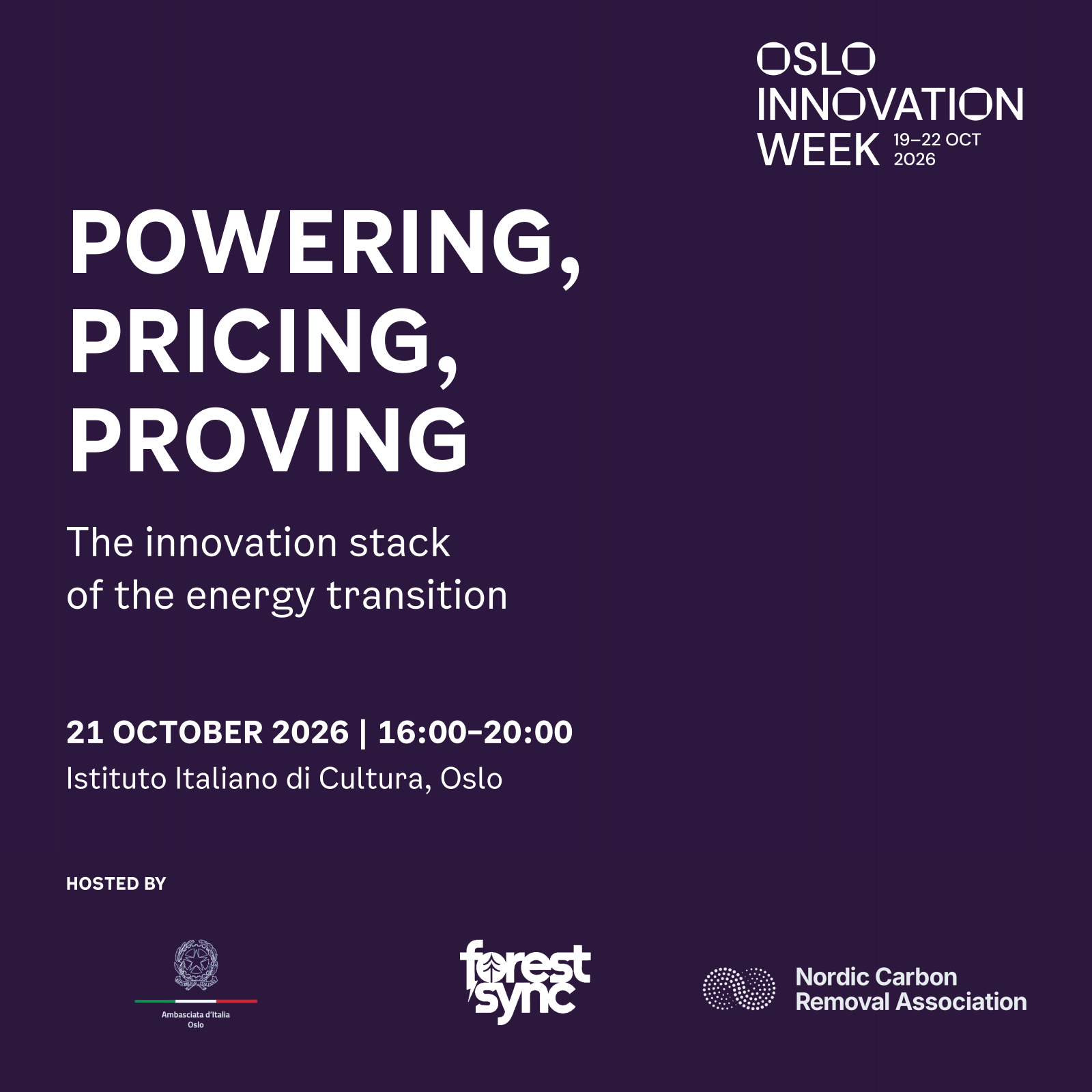
The innovation stack of the energy transition
Few events at Oslo Innovation Week put this much research on one stage. A Nobel Peace Prize laureate, energy research institutes from both Norway and Italy, and the Euro-Mediterranean Center on Climate Change, alongside Equinor and the companies actually building the carbon market.
Europe intends to buy carbon removals at scale from 2031. The capacity to deliver them has to be financed now, and it does not yet exist.
The energy transition is three problems, not one: generating clean power, building the market infrastructure to price and finance carbon removal, and proving any of it is real. Most events pick one. We take all three in a single afternoon, with the people actually building them.
The ocean runs through all of it. We open on the subsea grid that offshore wind depends on, and we close on what happened to that same ocean this summer.
Part of Oslo Innovation Week 2026, hosted with the Embassy of Italy in Norway. Free and in English.
Who it is for: founders, investors, industry, researchers and policy people working on energy, carbon markets and climate data.
Programme
16:00 Welcome and framing: H.E. Andrea Cavallari, Ambassador of Italy to Norway
16:10 Panel 1. Powering: the ocean's next energy
16:50 Networking break
17:00 Panel 2. Pricing: market infrastructure for carbon
17:40 Panel 3. Proving: what this summer changed
18:00 Closing and networking reception
Panel 1. Powering: the ocean's next energy
Norway built world-class capability offshore for oil and gas. How much of it transfers, how fast, and what new ocean energy technology needs in order to reach baseload. Ocean Grid from two sides, the operator's and the researchers', with the Mediterranean view alongside the North Sea one.
-
Hilde Røed, SVP Climate and Sustainability, Equinor. Presenting Ocean Grid, and how a major energy company reallocates capital and capability toward renewables without losing security of supply.
-
Christian Andresen, SINTEF Energi. Results from Ocean Grid Research: subsea grid development and market design for offshore wind, presented by the people who produced it.
-
Thomas Due, Hydrakraft. Wave energy from prototype toward reliable baseload, and what it takes to scale hard technology in Norwegian energy.
-
Laura Serri, RSE (Ricerca sul Sistema Energetico). The Mediterranean perspective, and how offshore energy is being developed in Italy.
Panel 2. Pricing: market infrastructure for carbon
Carbon is still bought bilaterally, through brokers and requests for proposal, at prices nobody else can see. What has to exist, technically and legally, for that to become a real market before Europe starts buying at scale.
-
Sean Cappone, CEO, ForestSync / Carbonomex. Why the market has to be built now rather than in 2031, and what changes when procurement moves to a centralised public exchange.
-
Per Richard Olsen, CFO, Removr. Scaling direct air capture, and what it takes on the balance sheet to finance capacity years before the demand lands.
-
Rebecka Kalnes, Carbon Centric. Capturing CO2 from waste-to-energy and industrial combustion, and what still blocks industrial capture from reaching final investment decision.
-
June Snemyr, Partner, Advokatfirmaet Thommessen. The legal architecture a centralised carbon venue requires: transparency, accountability, compliance.
Panel 3. Proving: what this summer changed
Europe has just come through a summer that will shape policy for years, and the seas overheated with it. What actually happened, what the science can and cannot attribute, and what measurement and public understanding now have to deliver.
-
Prof. Riccardo Valentini. Nobel Peace Prize laureate for his work with the IPCC. Director of Climate Impacts at the Euro-Mediterranean Center on Climate Change (CMCC), professor at the University of Tuscia, and founder of Nature 4.0. On the extreme overheating of oceans and seas this summer, what attribution science says about it, and how impact data turns into policy.
-
Timothy Lucie-Smith, Board member, Fondazione Sorella Natura. Turning a summer like this into public understanding rather than fatigue.
Moderated by Giulia Marzetti.