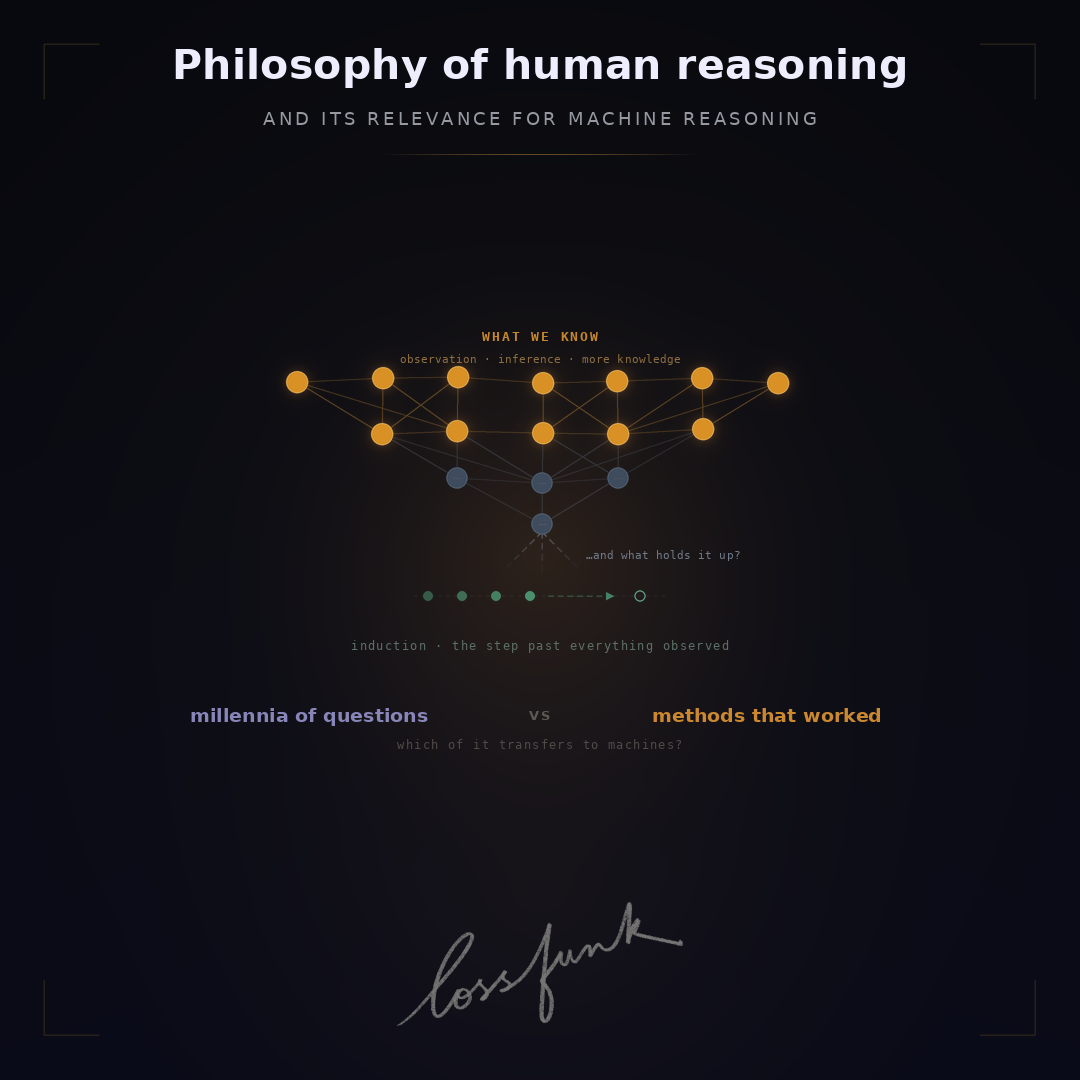
Philosophers have been building a theory of human reasoning for over two millennia. At a very high-level, this theory tries to critically examine, very critically, the following process of human reasoning: we acquire knowledge, make observations, and reason about these observations with our previously acquired knowledge to get more knowledge.
Philosophers asked very difficult questions about this process: Where did our a priori knowledge come from? Can we even prove the existence of anything beyond an idea in our mind? What are the different methods we apply to extend our knowledge through reasoning? How is inductive reasoning about things beyond those we have experienced even possible?
Anyone who encounters and thinks about these questions for the first time is amazed by the little foundation we have for our most closely held beliefs.
These are great questions, but, unfortunately, philosophers made remarkably little progress on these questions or their application to invent new methods of reasoning. On the other hand, tremendous progress has been made in psychology, mathematics and science in coming up with new methods of reasoning and, perhaps more importantly, in being able to use this knowledge to control nature.
In this talk, Himanshu will go over some of these ideas from philosophy and discuss their relevance for machine reasoning.
Pre read: (some context will help too)
-
Bertrand Russell, “The Problems of Philosophy.”
-
Bertrand Russell, “The Scientific Outlook.”
-
Karl Popper, “Conjectures and Refutations.”
-
Judea Pearl, “The Book of Why.”
-
Daniel Kahneman, “Noise: A Flaw in Human Judgement.”
About the speakers:
Himanshu Tyagi is a professor in the ECE Department of IISc and also a cofounder of Sentient, a crypto x AI project building open-source AGI, and of Arborum Labs, a startup building world models for critical networks.
He used to be an information theorist (which is a thing) and worked on applications of information theory to cryptography and AI. He co-authored a book titled Information Theoretic Cryptography which was published by Cambridge University Press
Join online: meet.google.com/tny-usqm-twk
Looking forward to seeing you!