Donald Hebb proposed in 1949 that a memory is held not in a single neuron but in a coalition of them - a group that wires itself together by co-firing and can then re-ignite from a fragment of the original input. For sixty-odd years, this was theory with almost no direct evidence. In 2012, optogenetics showed that by tagging the neurons active while a mouse learns to fear a box, shining light on only those cells later in a safe box causes the mouse to freeze.
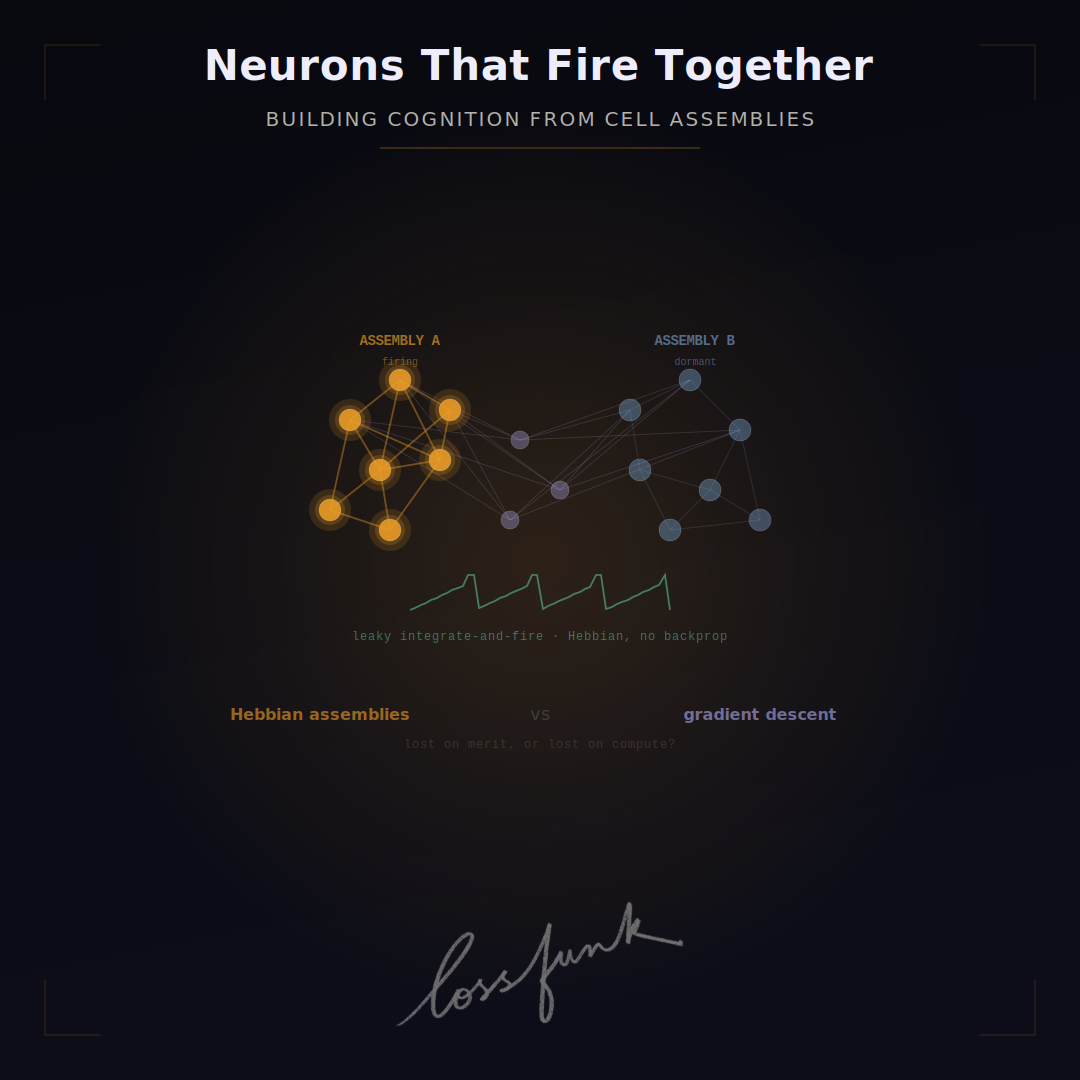
Long before that vindication, a small group of researchers were trying to build on the idea. The unit is a fatiguing leaky integrate-and-fire neuron: it spikes, it leaks, it tires. Learning is local and Hebbian, no labels, no global error signal, no backward pass.
Assemblies form, overlap, compete, and sustain recurrent activity after the stimulus is gone, which is different from a weight matrix.
Deep learning went the other way and won decisively, on a learning rule nobody has found in a brain. Twenty years of work has gone into showing cortex could approximate it; the approximations work, and then stop working at scale.
The open question is whether the neurobiological programme lost on merit or lost on compute, and what it still knows that gradient descent does not.
This talk covers the mechanism, the models, what they actually managed, and where they broke.
About the speakers:
Kailash Nadh has been CTO of Zerodha since 2013, where he started and still runs the tech team, and co-founded FOSS United, Rainmatter, the Indic Digital Archive Foundation, and Samagata
Kailash has a PhD in Artificial Intelligence & Computational Linguistics at Middlesex University, London (2011), under Christian Huyck - a thesis on Modelling Emergent Phenomena in Associative Memory with Neural Cell Assemblies.
Join online: meet.google.com/xqi-vjcv-dti
Looking forward to seeing you!