Description
This session, hosted in collaboration with the Japan Institute for Cyberspace Studies (JICSS), explores the technical intersection of AI and cybersecurity. Featuring a dedicated panel on the evolving zero-trust environment and emerging mandates, the session bridges institutional frameworks with rigorous engineering practices.
After the panel, we'll move on to three expert talks looking into the critical challenges of securing AI deployments, focusing on unified security infrastructures for LLMs, runtime observation and inline enforcement for agentic AI in production, and automated vulnerability remediation across large-scale open-source ecosystems.
Note: This time the format is different from the regular TAI events: we start earlier, then have 1 hour networking, and then continue with three talks. You can come to either or both of the parts (panel and/or talks).
Agenda
The sessions progress from high-level institutional frameworks down to specialized production security, culminating in global ecosystem impact. The panel will establish the macro-context (zero-trust and compliance mandates) to align both institutional and technical attendees before transitioning to the technical talks. Ramy will outline the broad threat landscape for LLMs and the architectural need for unified, end-to-end security infrastructures. Yury will narrow the focus to the immediate engineering challenges of Agentic AI, moving from framework-level concepts to concrete runtime production environments (APIs, observability, inline enforcement). Arpit will close with an expanded scope, looking at how AI agents can be proactively utilized to secure the foundational open-source repositories upon which the broader software ecosystem relies.
16:00 Doors open
16:30 - 17:30 Panel "AI and the Evolving Zero-Trust Environment"
17:30 - 18:30 Networking JICSS x TAI
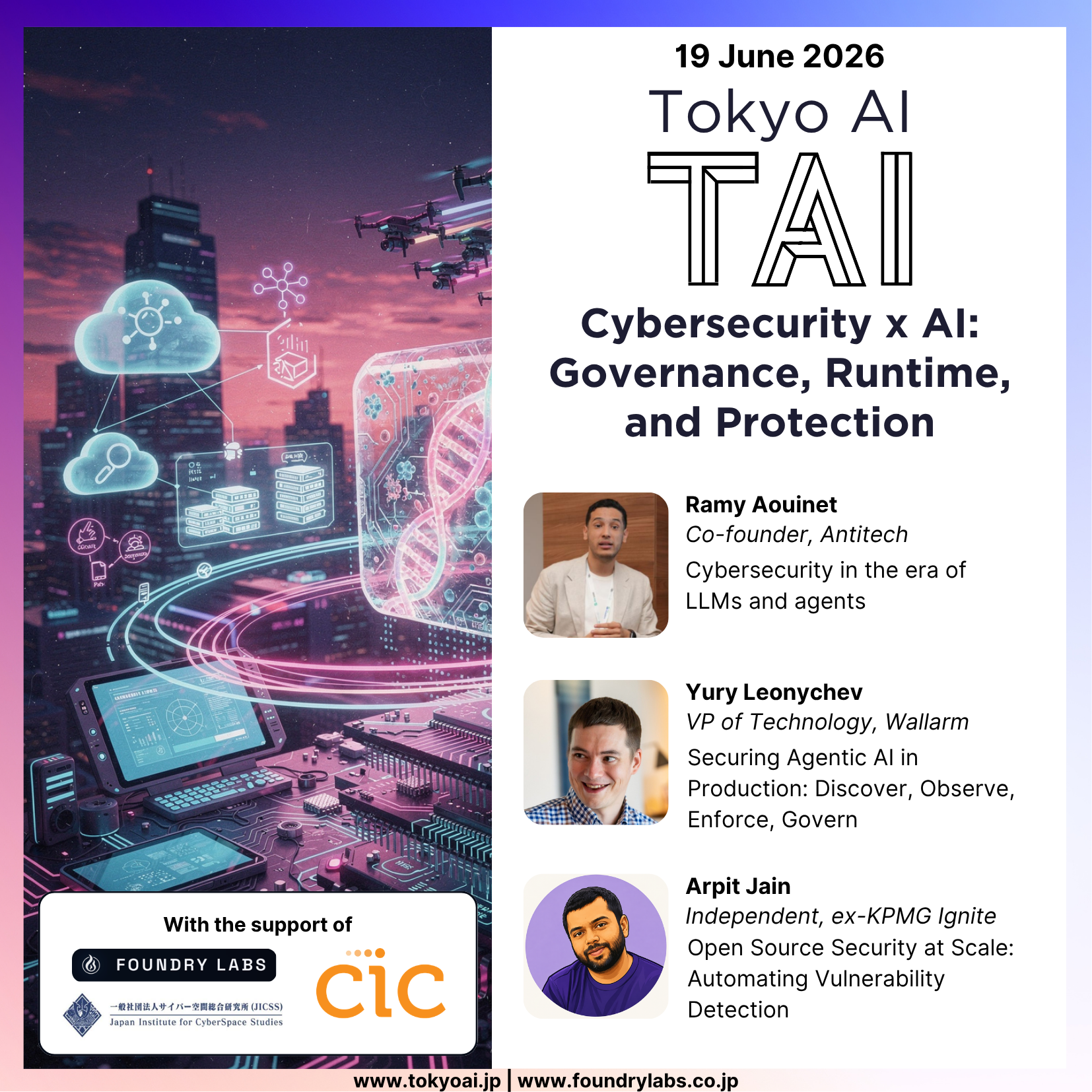
18:30 - 19:00 Cybersecurity in the era of LLMs and agents (Ramy Aouinet, Co-founder @ Antitech)
19:00 - 19:30 Securing Agentic AI in Production: Discover, Observe, Enforce, Govern (Yury Leonychev, VP of Technology @ Wallarm Inc.)
19:30 - 20:00 Open Source Security at Scale (Arpit Jain, Independent)
20:00 Doors close
Panel
We'll start with a collaboration panel between the Japan Institute for Cyberspace Studies (JICSS) and Tokyo AI (TAI) for a discussion about "AI and the evolving zero-trust environment and emerging mandates".
This panel discussion will include senior subject matter experts, technical experts, and active developers. The event will also include a networking session after the panel.
More details and the biographies of the speakers to follow.
Talks
Talk 1 - Cybersecurity in the era of LLMs and agents
Speakers: Ramy Aouinet (Co-founder, Antitech)
Abstract: Modern threats such as jailbreaks, prompt injection, model poisoning, and data exfiltration are already actively targeting every AI deployment, while traditional security tools remain reactive and outdated. The core problem is that there is no unified, end-to-end security infrastructure designed specifically for AI agents from the framework layer (how agents are built and orchestrated), to continuous testing (red teaming), to real-time protection (defensive layers against injections and leaks).
Bio: I’m Ramy Aouinet, co-founder of Antitech, an AI engineer. Recognized among the top 8 in Africa in AI, I focus on building robust and scalable intelligent systems, with expertise in reinforcement learning (RL), LLM infrastructure, and product architecture. I’ve worked on designing end-to-end AI pipelines, from research to production. I also served as an NVIDIA DLI instructor, where I taught topics ranging from deep learning to AI agents and anomaly detection. My work further extends into applying AI to neuroimaging, particularly for Autism Spectrum Disorder (ASD) and stroke research.
Talk 2 - Securing Agentic AI in Production: Discover, Observe, Enforce, Govern
Speakers: Yury Leonychev (VP of Technology, Wallarm Inc.)
Abstract: Agentic AI is reaching production faster than security teams can see it, let alone control it. Agents, MCP servers, and model integrations ship without centralized inventory; alerts arrive with no idea which agent acted, what data it touched, or which user triggered it; and most controls can only flag dangerous behavior after it has already executed. Meanwhile, compliance teams are asked to govern systems they can't observe.
Drawing on a decade of securing APIs at scale — and the data showing that the agentic AI attack surface is, at runtime, an API problem — I'll walk through four practical questions every team now faces: What AI is actually deployed? What is it doing right now? Can I block a bad action mid-flight? And can I prove any of it to an auditor? I'll cover runtime discovery of shadow AI, session- and user-level attribution across service hops, inline enforcement at the connection and kernel level without application code changes, and continuously generated evidence for frameworks like the EU AI Act and SOC 2. You will leave with a concrete model for treating AI agents as a first-class runtime security surface rather than a forecasting problem.
Bio: I'm VP of Technology at Wallarm, where I lead the engineering organization building the platform that discovers, protects, tests, and governs APIs and agentic AI systems for enterprises worldwide — trusted by companies like Samsung, Miro, and Panasonic to protect billions of API requests daily. Before Wallarm, I spent over a decade at Rakuten, progressing from Lead Architect to Senior Manager across security, SRE, and cloud architecture at scale. Earlier in my career, I ran penetration testing engagements for banks and industrial systems, then led security for Yandex.Passport covering fraud prevention and mobile authentication.
Talk 3 - Open Source Security at Scale: Automating Vulnerability Detection and Hardening in Top GitHub Repositories
Speakers: Arpit Jain (Independent)
Abstract: Many of the most popular projects on GitHub ship with unresolved security gaps in their CI/CD workflows and dependency configurations, often hiding in plain sight under inadequate code scanning practices. Drawing on five years of open source contributions, including merged pull requests in Kubernetes and Mermaid, I built an intelligent agent that systematically scans top repositories, detects security workflows that need hardening, and opens targeted pull requests to fix them. The focus is on small but high-impact changes: enforcing least-privilege permissions on GitHub Actions workflows and flagging vulnerable dependencies.
The results challenge the assumption that automated contributions are noise. Roughly ninety percent of the reviewed pull requests have been merged, with over 150 accepted across:
-
Organizations like Google, Microsoft, and AWS
-
Projects like NumPy, Vue.js, Node.js, Rust, LLVM, and the Kubernetes ecosystem
-
Major Apache Software Foundation projects like Kafka, Airflow, and Tomcat.
This talk will walk through how the agent works, what patterns it detects, how it generates pull requests that pass human review, and what the high merge rate reveals about the current state of open source security. Attendees will leave with a practical model for using automation to close security gaps across the ecosystem at scale.
Bio: Arpit is a freelance developer improving the security posture of major projects on GitHub. Alongside his open source contributions, he is exploring indie hacking, with a particular focus on data engineering and connecting disparate data sources. Arpit has presented on open source security at the Open Source Security Foundation (OpenSSF) conference organized by the Linux Foundation in 2025.
Organizers
Ilya Kulyatin is an entrepreneur with work and academic experience in the US, Netherlands, Singapore, UK, and Japan. He holds a BA in Economics, an MA in Finance, and an MSc in Machine Learning. He's a 3x founder, now helping Japan grow the local AI ecosystem through a not-for-profit community, Tokyo AI (TAI), while building an AI-native system integrator and solutions provider, Foundry Labs株式会社.
Supporters
Tokyo AI (TAI) is the biggest AI community in Japan, with 4,000+ members mainly based in Tokyo (engineers, researchers, investors, product managers, and corporate innovation managers).
Privacy Policy
We will process your email address for the purposes of event-related communications and ongoing newsletter communications. You may unsubscribe from the newsletter at any time. Further details on how we process personal data are available in our Privacy Policy.