Can you build a chess engine that plays well against openings it has never seen?
That is the whole challenge. Five days, an original model, and a hidden evaluation you cannot practise against.
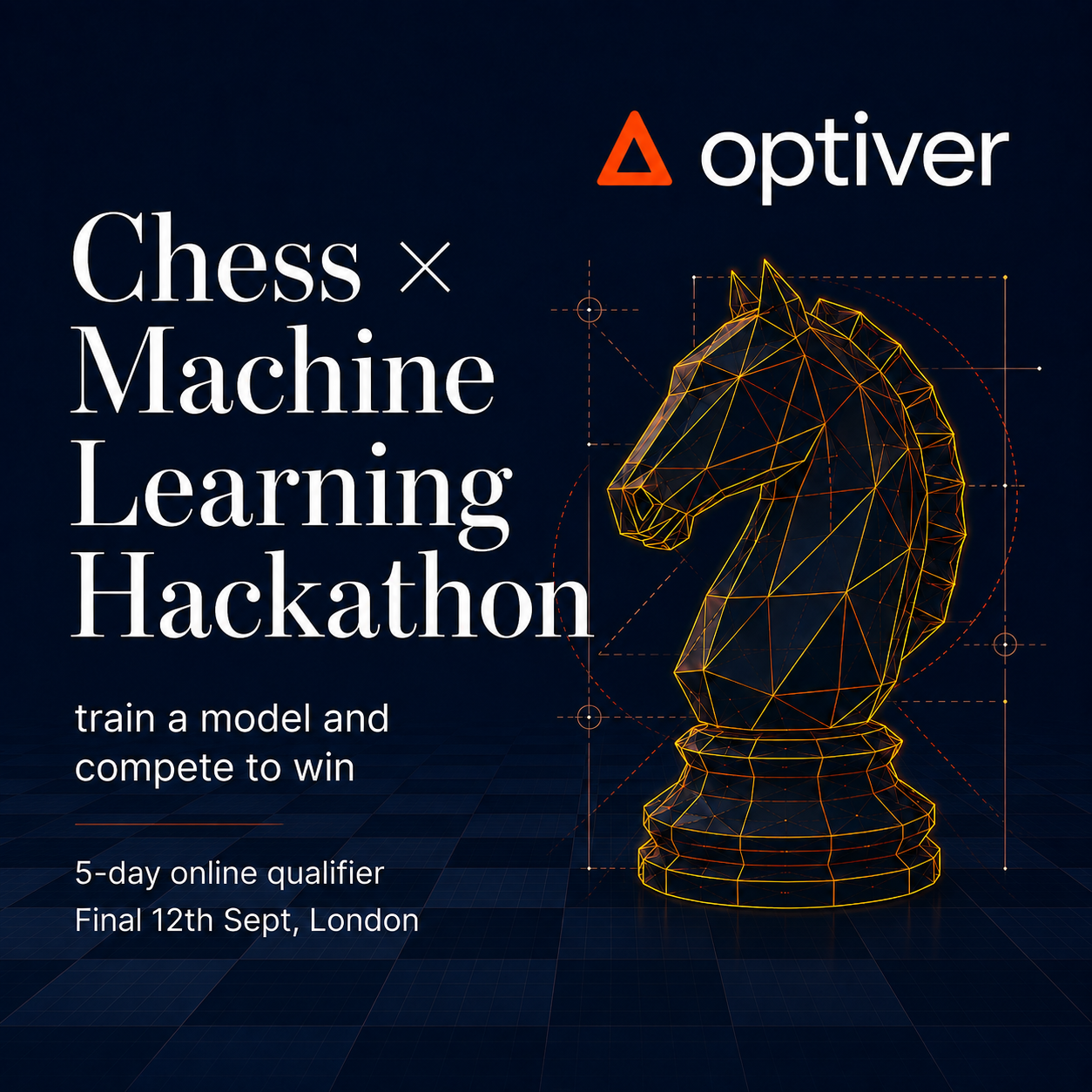
This Chessathon is a five-day online competition run sponsored by Optiver. Teams build an AI chess engine from scratch, iterate against a public benchmark, then submit one frozen model for evaluation against opponents and openings they have never seen. The top 16 teams advance to an in-person final at Encode Hub in London.
Where you compete
All registration, team formation, submissions and standings happen on the competition platform
Signing up here on Luma registers your interest. You will need to create an account on the platform to compete.
How it works
The online phase runs Mon 7 - Fri 11 September and is a structured build sprint, not a five-day marathon.
-
Day 1 - Launch. Kickoff, team confirmation, rules and starter-kit walkthrough. You get a sample bot, data guidance, public baselines and compute limits.
-
Day 2 - Build. Feature design, training, first valid submissions.
-
Day 3 - Iterate. Benchmark, compare experiments, improve move selection. Technical office hours and leaderboard updates.
-
Day 4 - Optimise. Robustness, inference time and generalisation.
-
Day 5 - Freeze. Choose one immutable final submission and complete your model card. Uploads close and hidden evaluation begins.
The public leaderboard during the week is a development aid. It is not the final result.
The rules
-
Teams of one to three people. Up to three scored submissions per day.
-
The neural network must be a meaningful part of move selection. Existing chess engines and pre-trained chess models are excluded from the inference pipeline.
-
Every submission includes source code, model weights, a short methodology note and a fixed random seed.
-
All engines run under identical CPU, memory and move-time budgets.
How you are judged
80% automated hidden evaluation, 20% technical review.
Hidden match performance carries the most weight (60%), with robustness, compute efficiency, modelling quality, originality and reproducibility making up the rest. Every opening is played from both colours across multiple seeds. The top 16 composite scores advance.
The final
The top 16 teams (up to 48 finalists) come to Encode Hub, 41 Pitfield Street, London N1 6DA on Saturday 12 September, 09:00 to 18:00.
You will refine your engine under a newly revealed constraint, freeze again, then compete in a five-round Swiss tournament followed by a top-eight knockout. The day also includes technical presentations, a workshop from the Optiver team, and prize presentation.
Optiver and hiring
Optiver is a global market maker and the sponsor of this event. Their team will be judging at the final, running a workshop and presenting a sponsor prize.
Finalists will be invited, separately and entirely optionally, to share their CV and contact details with Optiver for potential hiring conversations. This is a separate opt-in. It is not a condition of entering, being selected, or attending the final, and you can take part fully without it.
Your organisers
Arham Shuaib - CS at Warwick, currently interning at Combinely (YC X25). Designed this competition's format, and works at the intersection of ML and quantitative research.
Tanuj Kakumani - Founder of simplytk, previously co-founder of A* AI (10k users, four-figure MRR). Spring internships at IMC Trading, Citadel and Cornerstone Research, and currently at YC in San Francisco.