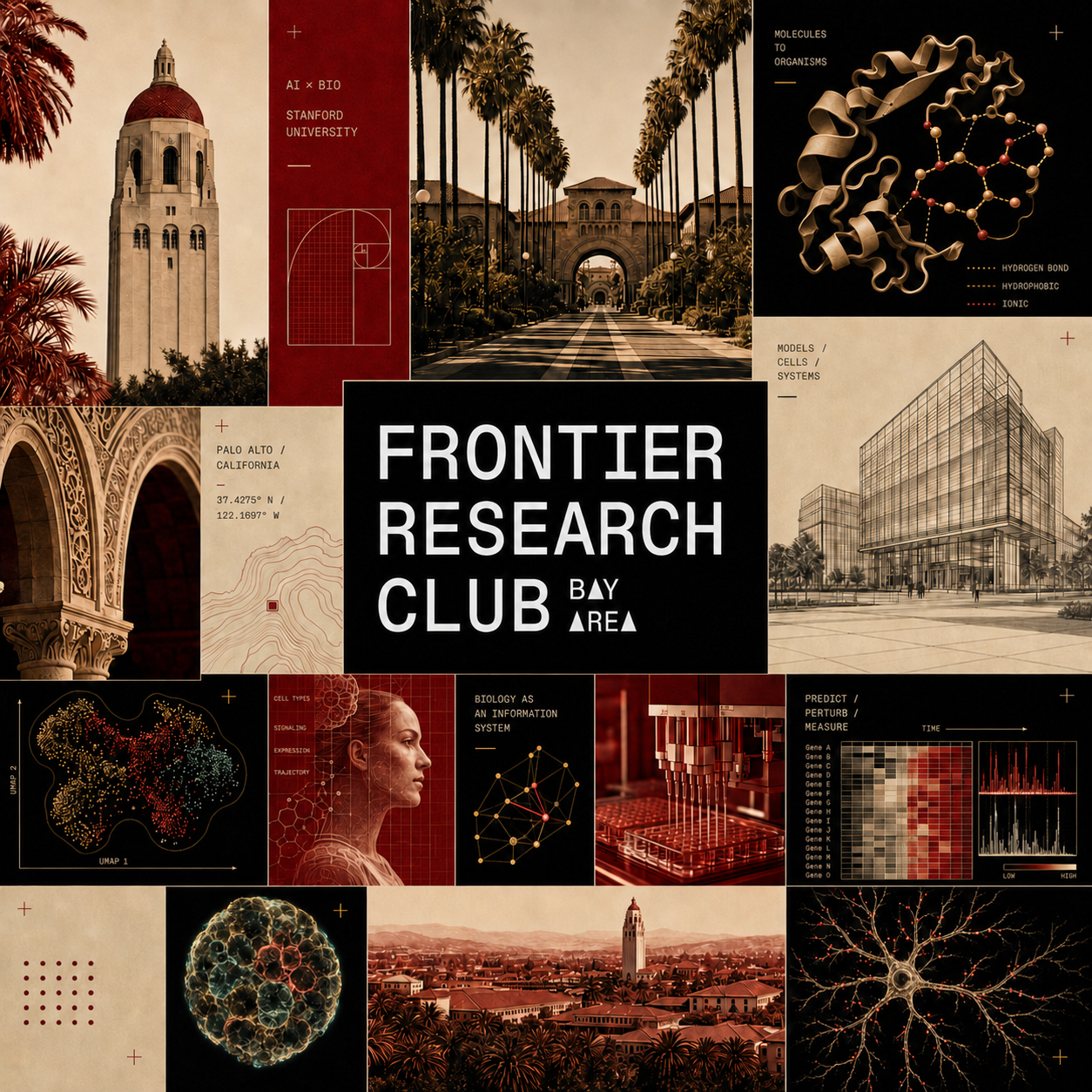
The Frontier Research Club is a curated forum for rigorous, technical discussion at the frontier of AI. We convene researchers from the frontier labs, Stanford, Berkeley, and the teams building in production to examine concrete work, papers, methods, and results, with a bias toward assumptions, evaluation methodology, failure modes, and what would count as convincing evidence.
Each session features 2–3 talks selected for rigor and discussion value. Presentations are intentionally brief so the majority of time is reserved for questions and critique. Papers and supporting materials are shared in advance to ensure a high-baseline conversation.
Agenda
5:30 PM, Doors open5:30–6:30 PM, Networking + light dinner6:30–7:00 PM, Talk 1 + Q&A7:00–7:30 PM, Talk 2 + Q&A7:30–7:50 PM, Guided discussion with both speakers7:50–8:30 PM, Networking
Presenters and topics
Talk 1, Repairing a Broken Molecular Machine in Colorectal Cancer
Colorectal cancer is the second leading cause of cancer death worldwide, and more than 80% of cases trace back to a single broken molecular machine, the destruction complex that normally keeps cell growth in check. Despite thirty years of study, there is still no approved drug targeting this pathway.In this talk, I'll share how we mapped this machine at single-letter resolution using state-of-the-art genome editing, then used careful biochemistry to uncover a hidden logic: in cancer cells, the very protein the machine is meant to destroy becomes the glue holding it together. That insight led to a surprising proof-of-concept, by precisely tuning the binding affinities between the machine's components, we can repair the broken complex and slow cancer cell growth. It's a reminder that the most actionable therapeutic ideas often come from fundamental, mechanism-first research.
Ganesh Pusapati, PhD is a Senior Research Scientist in the Department of Biochemistry at Stanford University (Rohatgi Lab). He co-led the July 2026 Nature Genetics study mapping functional mutations across the WNT/β-catenin destruction complex. He completed his PhD at the University of Ulm and postdoctoral training at Stanford with Suzanne Pfeffer and Rajat Rohatgi.
Talk 2, Learning the Cell: What Atlas-Scale Models Can See
The scale bet holds that enough measured cells, and models trained across them, yield something mechanism-first biology can't: regularities that generalize across tissues, diseases and perturbations. This talk examines what today's models actually learn from atlas-scale single-cell data, how to evaluate them honestly, and what a virtual cell would have to predict before you trusted it to point at a drug target.
Dr. Angela Oliveira Pisco is Director of Data Science at the Chan Zuckerberg Initiative, where she leads work at the AI × bio intersection building tools and models to advance the understanding of disease mechanisms. She previously led computational biology at the Chan Zuckerberg Biohub San Francisco, where she was a driving force behind large-scale single-cell atlas efforts.
Guided Discussion
Both speakers return to the stage for a joint discussion led by Aaran Vijayakumaran of Stanford Biochemistry. The conversation will press on the night's question, when does mechanism beat scale, when does scale beat mechanism, and what would count as evidence either way, before opening to the room.
Want to present your work?
Frontier Research Club is built around researchers willing to put concrete work in front of a technically serious room. If you have a research paper you would like to discuss at an upcoming session, submit it for consideration.
Submit your paper here
Who should attend
-
Experimental biologists working across cancer biology, functional genomics, perturbation screens and wet-lab systems
-
Computational biologists and bioinformaticians working with single-cell and atlas-scale data
-
ML researchers building foundation models, generative models and benchmarks for biological data
-
Drug-discovery and translational teams from biotechnology and pharmaceutical companies
-
Research engineers and laboratory-automation teams building the layer between the model and the bench
-
Founders building in AI × bio and the investors backing them
Capacity is limited.
We will take photos and short video clips for event recap and promotion. By attending, you consent to being photographed and recorded, and to the use of those images and clips by the organizers on social media and other event marketing channels.
🌐 Connect with Frontier Research Club
-
Luma Calendar: luma.com/frontiersyndicate
-
YouTube: youtube.com/@FrontierResearchClub
-
Instagram: @frontierresearchclub
-
Email: [email protected]
Hosted by
The Frontier Syndicate is a venture community connecting frontier-technology researchers, builders and investors through curated convenings and early-stage capital. Across the Bay Area, we produce a recurring series of research forums, builder nights and intimate investor dinners, and back exceptional companies emerging from the laboratories, communities and technical networks we convene.