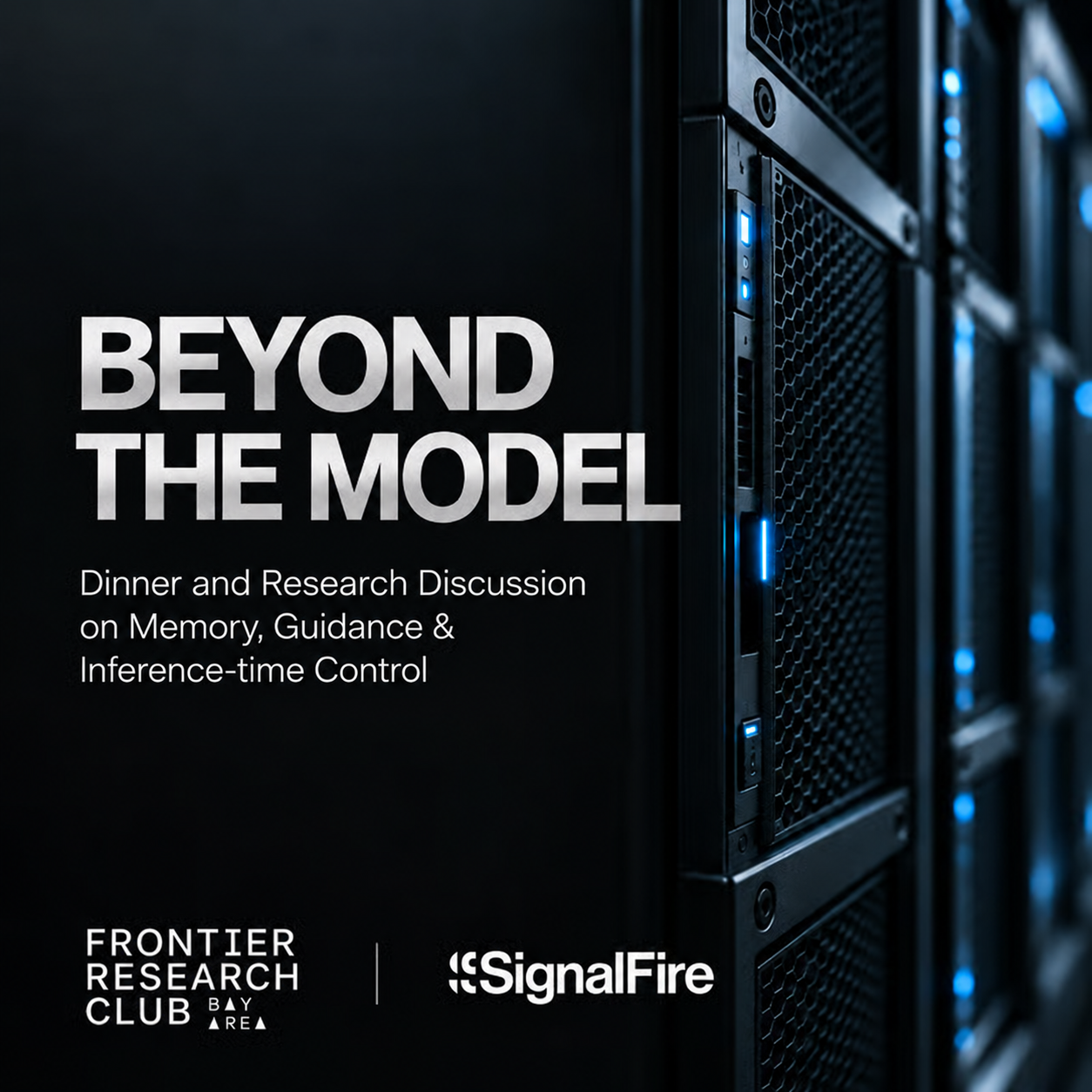
How much intelligence lives outside the model?
Frontier AI systems are increasingly defined by more than their weights. How generation is guided, what state persists, what tools are available, and how the surrounding system structures reasoning can materially change what a model does.
This session examines that idea from two directions: one talk studies inference-time control inside a generative model*, showing how changes to classifier-free guidance can steer diffusion models away from memorized training examples without retraining; the other studies* capability created around a model*, using an ARC-AGI system that combines an existing coding agent with executable reasoning and persistent memory to produce very different behavior from the underlying model alone.*
The shared question: when model weights stay fixed, how much can memory, guidance, tools, and system design change what the AI can do?
Co-hosted with SignalFire.
The Frontier Research Club is a curated forum for rigorous, technical discussion at the frontier of AI. We cover the systems, methods, and hardware that determine how frontier models are trained, served, and steered. We convene researchers from the frontier labs, Stanford, Berkeley, and the teams building in production to examine concrete work — papers, methods, and results — with a bias toward assumptions, evaluation methodology, failure modes, and what would count as convincing evidence.
Each session features 2 talks selected for rigor and discussion value. Presentations are intentionally brief so the majority of time is reserved for questions and critique. Papers and supporting materials are shared in advance to ensure a high-baseline conversation.
Agenda
5:30pm: Doors open5:30pm – 6:30pm: Networking + light dinner6:30pm – 8:00pm: Research presentations + discussion8:00pm – 8:30pm: Networking
Presenters & topics
Talk 1: Classifier-Free Guidance Inside the Attraction Basin May Cause Memorization (CVPR 2025)
Anubhav Jain is an Applied Researcher at Apple working on post-training and safety. His NYU PhD dissertation focused on inference-time steering and responsible image generation with diffusion models — this CVPR 2025 paper, co-authored with collaborators at NYU and Sony AI, comes from that line of work.
Diffusion models sometimes reproduce their training images exactly. This work locates the cause in an attraction basin in the denoising process — and shows that steering the trajectory at inference time, by withholding classifier-free guidance until an ideal transition point and applying a new "opposite guidance" technique, escapes memorization entirely: no retraining, no weight changes, with image quality and prompt alignment preserved.
Pre-read: Classifier-Free Guidance Inside the Attraction Basin May Cause Memorization
Talk 2: CCARC — Memory, Code Execution, and the Minimum Ingredients for Self-Improving Agents
Dastin (Yuanjun) Huang is an AI Researcher at Sentient Labs working on self-evolving agents. His recent independent research explores how memory, tool use, and agent harnesses can change the capabilities of an otherwise fixed foundation model — including CCARC, an open-source system built to test these ideas on ARC-AGI-3.
ARC-AGI-3 requires an agent to infer unfamiliar rules, discover rewards, and adapt across an interactive environment. CCARC pairs an existing Claude Code agent with two simple primitives: code execution as part of the reasoning loop and persistent file-based memory written at each level boundary. Dastin reports 100% RHAE on the ARC-AGI-3 public demo environments, compared with roughly 40% for the published harness-free baseline using the same underlying model, and 96.8% on the ARC-AGI-2 public evaluation split. The work uses that gap to ask a larger question: when the model itself stays fixed, what combination of memory, tools, and system architecture is sufficient for an agent to improve from experience?
Pre-read: CCARC — ARC-AGI-3 Recursive Self-Improving Agent
Want to present your work?
If you have a research paper you’d like to discuss at one of our next sessions, please submit it for consideration. Submit your paper here!
Who should attend
-
Researchers and engineers working on agent architectures, memory, and inference-time reasoning
-
Researchers working on diffusion, generative models, and inference-time steering
-
Engineers building systems around foundation models with tools, persistent state, and executable reasoning
-
Founders and technical leaders exploring agentic systems, self-improving AI, and intelligence evaluation
Capacity is limited.
We will take photos and short video clips for event recap and promotion. By attending, you consent to being photographed and recorded, and to the use of those images and clips by the organizers on social media and other event marketing channels.
🌐 Connect with Frontier Research Club
-
Luma Calendar: luma.com/frontiersyndicate
-
YouTube: youtube.com/@FrontierResearchClub
-
Instagram: @frontierresearchclub
-
Email: [email protected]
Hosted by
The Frontier Syndicate is a venture community connecting frontier tech researchers, builders, and investors through curated convenings and early-stage capital. Across the Bay Area, we host a recurring series of research forums, builder nights, and intimate investor dinners — and back exceptional companies emerging from the labs, communities, and technical networks we convene.
SignalFire is an AI-native venture capital firm with roughly $3B under management, backing founders from pre-seed through Series B across applied AI, infrastructure, healthcare, cybersecurity, and enterprise. SignalFire pairs early capital with hands-on data science, talent, and go-to-market support — and is co-hosting this session at its San Francisco headquarters.