The best research conferences create a rare kind of intellectual density. For a few days, you are surrounded by people working on the same difficult questions, people who immediately understand why those questions matter.
Then everyone goes home, and the conversation fragments across labs, companies, cities, and time zones.
Voice Research Club was created to keep that conversation going.
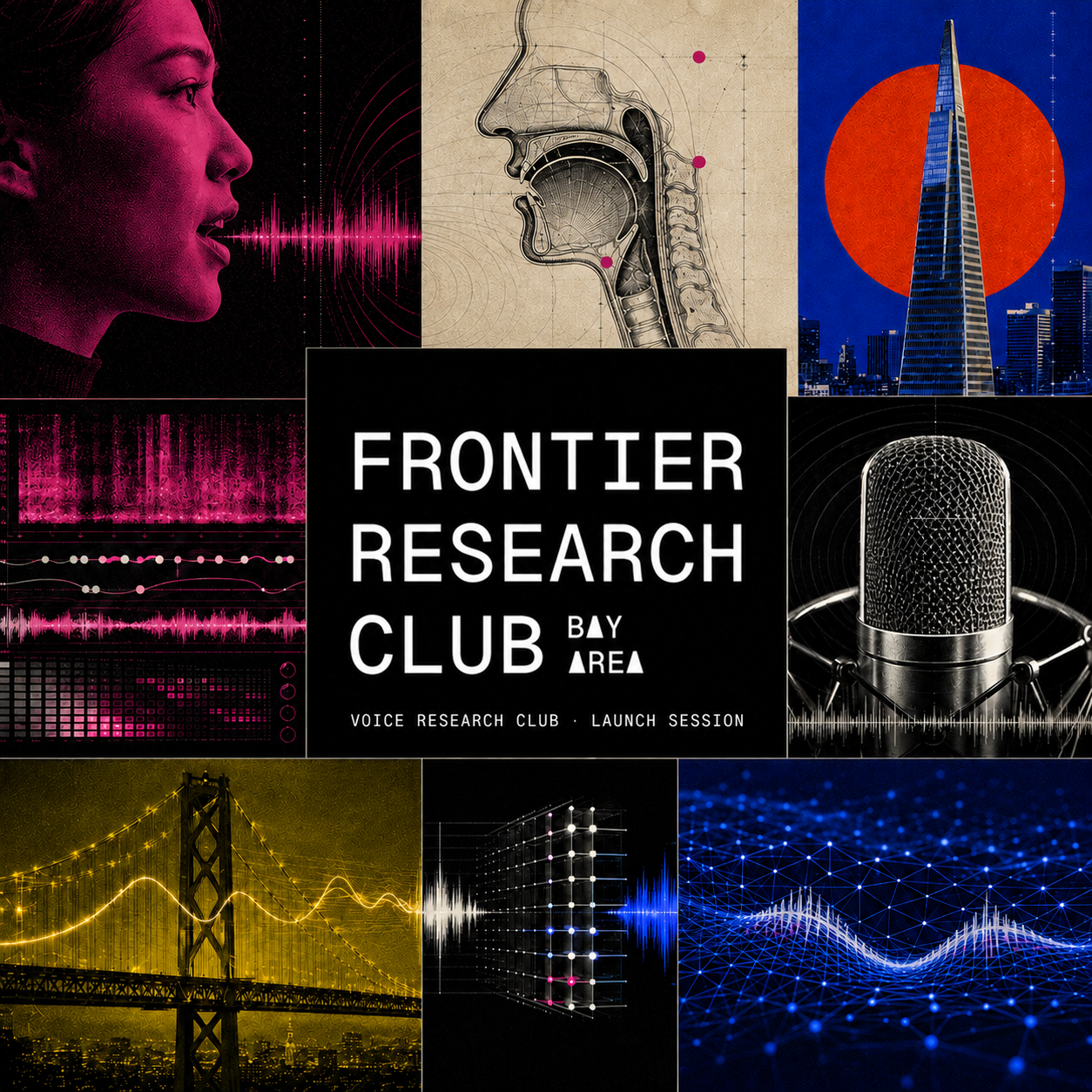
Voice Research Club is a Voice Arena initiative launching in collaboration with the Bay Area Frontier Research Club. Designed with researchers, for researchers, VRC will convene the voice and speech community for recurring, paper-driven technical sessions centered on current work, open problems, and rigorous discussion.
VRC is research-first and discussion-led. It is not a demo day, vendor showcase, or pitch event. Researchers from companies, universities, and independent labs are welcome; sales presentations are not.
Future sessions will be shaped by community paper submissions and recommendations, with final selections curated for technical rigor and discussion value. The ambition is to establish monthly VRC sessions across six global research hubs, beginning here in San Francisco on September 3.
The evening will feature two concise technical presentations followed by an extended research discussion. The talks provide the substrate; the Q&A is the main event.
Agenda
5:30pm: Doors open5:30pm – 6:30pm: Networking + light dinner6:30pm – 8:00pm: Research presentations + discussion8:00pm – 8:30pm: Networking
Presenters & topics
Talk 1, Voice and Role Control for Full-Duplex Speech
Rajarshi Roy · Researcher, NVIDIA
Full-duplex speech models can listen and speak simultaneously, enabling turn-taking, interruptions, and backchannels, but existing systems have largely been limited to a single role and fixed voice.
PersonaPlex introduces both role and voice control through a single system prompt: role conditioning through text and voice conditioning through speech samples. The model is trained using a large synthetic corpus of prompt-and-conversation pairs generated with open-source language and text-to-speech models.
Rajarshi will discuss how this hybrid conditioning works, what synthetic conversational data can and cannot teach a duplex model, and how PersonaPlex performs across role adherence, speaker similarity, latency, and naturalness.
The larger question under examination: How should we evaluate full-duplex behavior, and what do today’s benchmarks still miss?
Paper: PersonaPlex: Voice and Role Control for Full-Duplex Conversational Speech Models
Project: NVIDIA ADLR PersonaPlex
Rajarshi Roy is a researcher in NVIDIA’s Applied Deep Learning Research group and the lead author of PersonaPlex. His work focuses on conversational speech systems, full-duplex interaction, and controllable voice models.
Google Scholar
Talk 2, What It Takes to Scale Real-Time Voice Models
Akshat Mandloi · Co-Founder & CTO, Smallest.ai
Voice AI is earlier than it looks. Making systems that genuinely listen, reason, remember, and respond in real time raises problems that parameter count alone doesn't solve: latency, interruptions and turn-taking, speech understanding, emotional nuance, reliability, cost, and how to evaluate any of it honestly. Drawing on Smallest.ai's work across text-to-speech, speech recognition, conversational language models, and native speech-to-speech systems, Akshat will map where voice AI actually stands today, why the hard problems are still open, and what it takes to make voice models substantially more capable while staying fast and efficient enough for live conversation. The question under examination: where exactly are we on the path to natural real-time voice intelligence, and what moves the boundary?
Learn more about Smallest.ai · Akshat on LinkedIn
Akshat Mandloi is the co-founder and CTO of Smallest.ai, where he leads work across real-time voice AI, speech models, and low-latency infrastructure. His work spans multilingual speech models, conversational intelligence, model efficiency, and production-scale inference. Before Smallest.ai, he worked on autonomous vehicle perception, electric-vehicle powertrains, and applied machine learning.
Want to Present Your Work?
If you have a research paper you would like to discuss at a future Voice Research Club session, submit it for consideration.
Submit your paper here
Who Should Attend
-
Speech, audio, and multimodal researchers
-
Research engineers building TTS, STT, speech-to-speech, or voice-agent systems
-
Teams working on voice benchmarks, datasets, infrastructure, and evaluation
-
Technical founders and product leaders building in voice AI
-
Researchers working on multilingual speech, accessibility, safety, or human-computer interaction
-
Investors and ecosystem leaders with an active technical interest in the category
Capacity is limited. Registration requires approval.
We will take photos and short video clips for event recap and promotion. By attending, you consent to being photographed and recorded, and to the use of those images and clips by the organizers on social media and other event marketing channels.
🌐 Connect with Frontier Research Club
-
Luma Calendar: luma.com/frontiersyndicate
-
YouTube: youtube.com/@FrontierResearchClub
-
Instagram: @frontierresearchclub
-
Email: [email protected]
Hosted by
The Frontier Syndicate
The Frontier Syndicate connects frontier-technology researchers, builders, and investors through curated research forums, build nights, private dinners, and early-stage capital. Its Frontier Research Club is a recurring forum for rigorous technical discussion, built around current work, open questions, and high-signal exchange across the Bay Area research ecosystem.
Voice Arena
Voice Arena is building the evaluation layer for voice AI. Its TTS and STT leaderboards compare leading voice models across languages, use cases, and deployment conditions, giving researchers and builders a clearer view of where the frontier is moving.
Learn more about Voice Arena
Venue Partner
Array Ventures
Array Ventures is a San Francisco-based early-stage venture firm backing deeply technical founders from inception through Series A, with a focus on AI infrastructure, data, security, and enterprise software. Through Array AI Labs, the team also builds and experiments with frontier AI tooling alongside the founders it supports.
Learn more about Array Ventures