Description
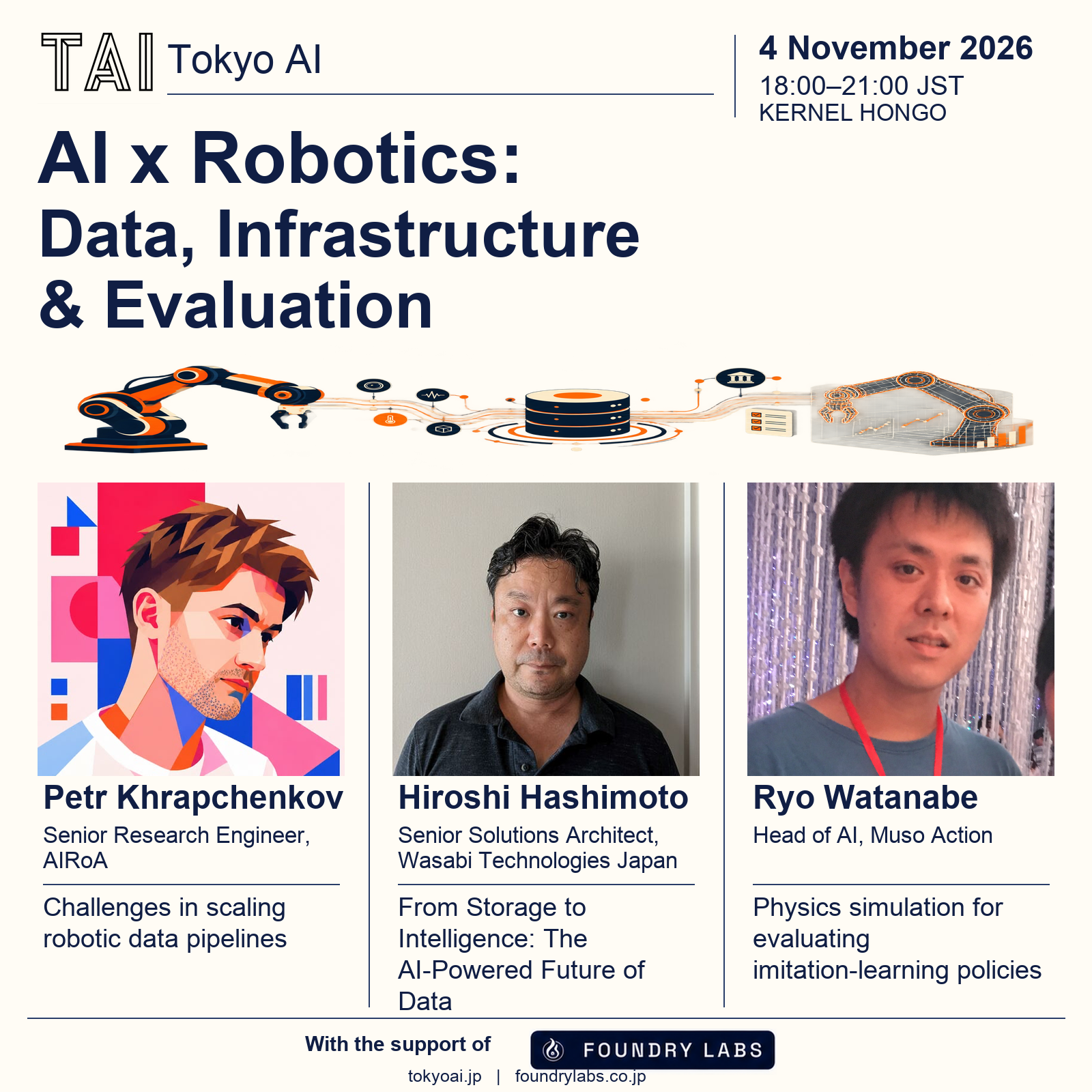
How do we build the infrastructure that helps physical AI scale and improve? Join Tokyo AI for an evening exploring three complementary challenges: moving robot data reliably from fleets into training, building persistent data platforms for production AI, and evaluating learned robot policies before spending scarce time on real hardware.
Petr Khrapchenkov (AIRoA) will share lessons from processing thousands of hours of robot data each month. Hiroshi Hashimoto (Wasabi Technologies Japan) will explore the storage foundations of production RAG, with an MCP demo. Ryo Watanabe (Muso Action) will show how physics simulation, Real2Sim scenes and cloud GPUs help evaluate imitation-learning policies before costly hardware runs.
For robotics and ML engineers, researchers, data infrastructure practitioners, and technical founders.
When: Wednesday, November 4, 2026, 18:00-21:00 JST.Where: KERNEL HONGO, 3F, 4-1-4 Hongo, Bunkyo City, Tokyo 113-0033, Japan.Language: English.
The running order may be updated as final speaker logistics are confirmed.
Agenda
Provisional running order. Each 30-minute talk slot includes Q&A.
-
18:00 - Doors open
-
18:25-18:30 - Welcome
-
18:30-19:00 - Talk 1: Challenges in scaling robotic data pipelines (Petr Khrapchenkov)
-
19:00-19:30 - Talk 2: From Storage to Intelligence: The AI-Powered Future of Data (Hiroshi Hashimoto)
-
19:30-20:00 - Talk 3: Physics simulation for evaluating imitation-learning policies (Ryo Watanabe)
-
20:00-21:00 - Networking
-
21:00 - Doors close
Talks
Talk 1: Challenges in scaling robotic data pipelines
Speaker: Petr Khrapchenkov, Senior Research Engineer, AIRoA.
Abstract: Robots generate data continuously and at massive scale, and the hard part is making sure all of it reaches a training run. Every stage between recording and training is a point where data can be dropped, corrupted, or become too slow and expensive to use. As a fleet grows, these problems grow with it, and a pipeline that worked for a handful of robots stops working for hundreds.
In this talk, we present the production pipeline we use to process thousands of hours of robot data every month. We follow the data end to end, from raw recordings through the data lake to training datasets flowing into the training pipeline, and focus on three areas: ingress (moving data off the robots reliably and without loss), storage (keeping large volumes durable, organized and affordable), and query (finding the right data and turning it into training datasets efficiently).
For each area, we share the problems we faced, the design choices we made, and the lessons we learned, including where physical AI pipelines differ from regular data pipelines and which of our decisions carry over to other teams building similar systems.
Bio: Petr Khrapchenkov is a Senior Research Engineer at AIRoA (AI Robot Association), where he leads development of the data platform for its robot foundation models and has co-led its large-scale robot datasets. He began this work at Matsuo-Iwasawa Lab, The University of Tokyo, building AIRoA's data collection systems alongside research on tactile and navigation models.
Before moving into physical AI, Petr worked as a software engineer and spent eight years at Hongo Aerospace, where as Chief Engineer he designed hardware, software and navigation systems for autonomous drones in underground and GPS-denied environments. He holds an MEng in Aeronautics and Astronautics from The University of Tokyo.
Talk 2: From Storage to Intelligence: The AI-Powered Future of Data
Speaker: Hiroshi Hashimoto, Senior Solutions Architect, Wasabi Technologies Japan.
Abstract: RAG helps AI models answer questions using a company's own data instead of relying only on what they were trained on. But most RAG discussions focus on embedding models and vector databases, while ignoring where the underlying data actually lives. This session looks at why a persistent data platform like Wasabi enables production RAG applications to keep improving without rebuilding their data from scratch. It will also contain a simple demo of managing the platform using MCP.
Bio: Hiroshi Hashimoto is a Solutions Architect at Wasabi specializing in cloud storage-centric data infrastructure. A former pre-sales engineer for cloud storage, DaaS, and virtualization vendors, he brings deep multi-vendor expertise in designing flexible hybrid cloud solutions.
Talk 3: Physics simulation for evaluating imitation-learning policies
Speaker: Ryo Watanabe, Head of AI, Muso Action.
Abstract: Training loss and open-loop metrics can rule a robot policy out, but only closed-loop runs tell you whether it actually works. On real hardware those runs are slow, hard to reproduce, and impossible to scale to dozens of candidate policies. This talk shows how Muso Action uses a physics simulator (Isaac Lab Arena) to evaluate imitation-learning policies: many cells running in parallel on one GPU, identical initial states so comparisons are fair, and lighting or object poses changed with a single setting. Simulation-based evaluation becomes more valuable the more we narrow the gap between sim and real, so we also cover Real2Sim: photorealistic scenes with scanned products, and matching actuator parameters as well as the robot's low-level controller. Finally, we show how on-demand cloud GPUs make simulation evaluation available to the whole team.
Bio: Ryo Watanabe is Head of AI at Muso Action, where he leads the development of robot foundation models, from large-scale data collection to training and evaluation. He is also the principal researcher for Muso Action's robot foundation model project under GENIAC, Japan's national generative AI program run by METI and NEDO. He previously worked at Sony and then led the VLA team at Telexistence, collaborating with US tech companies such as Physical Intelligence.
Organizers
Ilya Kulyatin is an entrepreneur with work and academic experience in the US, Netherlands, Singapore, UK, and Japan. He holds a BA in Economics, an MA in Finance, and an MSc in Machine Learning. He's a 3x founder, now helping Japan grow the local AI ecosystem through a not-for-profit community, Tokyo AI (TAI), while building an AI-native system integrator and solutions provider, Foundry Labs株式会社.
Supporters
Foundry Labs K.K. is a Tokyo-based AI systems integrator and solutions provider, delivering end-to-end support for enterprises: from strategy design through implementation, deployment, and operations. They tailor AI to each client's operational, regulatory, and security requirements, with hands-on experience across finance, government, and industry, and a track record of shipping production systems in secure and regulated environments.
About TAI
Tokyo AI (TAI) brings together engineers, researchers, investors, product managers, and corporate innovation leaders building AI in Japan and connecting with the global ecosystem.
Privacy Policy
We will process your email address for the purposes of event-related communications and ongoing newsletter communications. You may unsubscribe from the newsletter at any time. Further details on how we process personal data are available in our Privacy Policy.