AI can generate Ruby code. The harder skill is knowing how to work with it well.
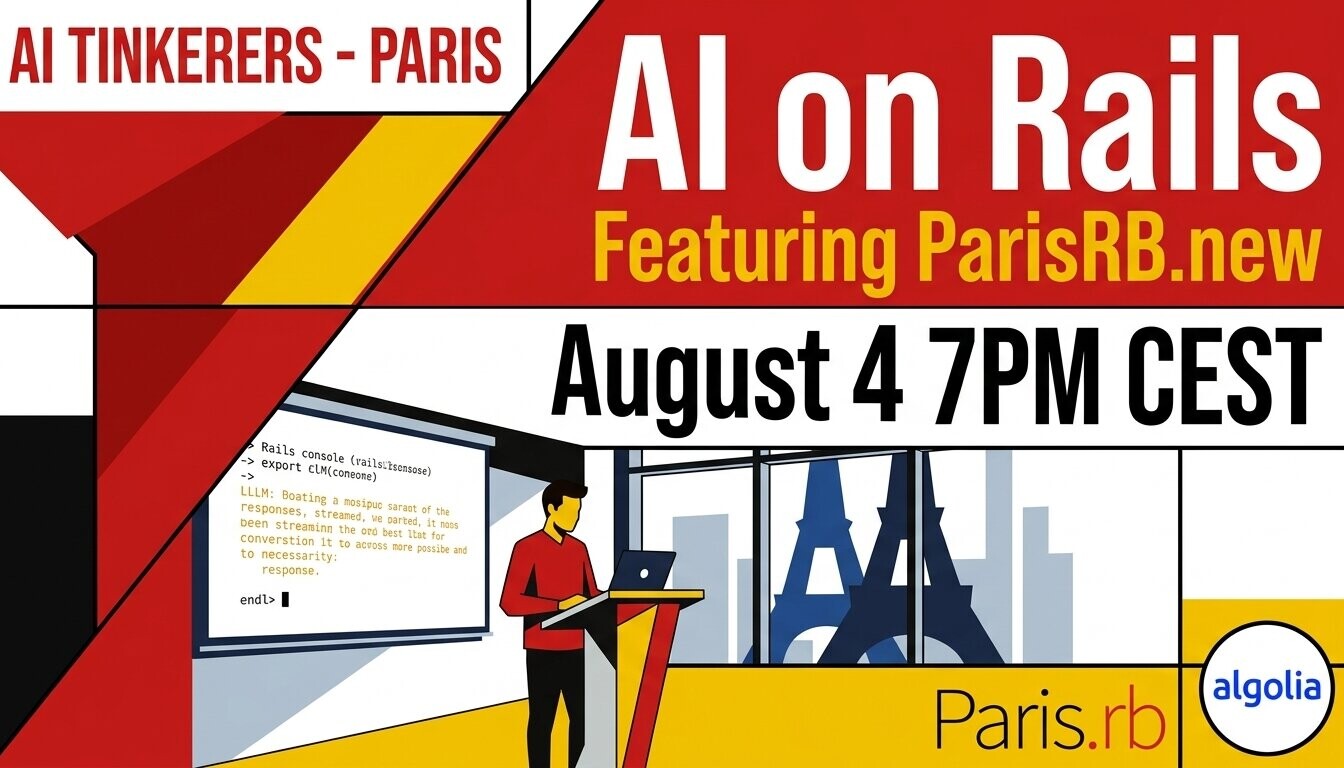
On August 4, AI Tinkerers Paris and ParisRB.new are joining forces at Algolia for a hands-on evening about the new practices behind AI-assisted development.
You will learn how experienced builders use AI in real projects, question them about their tools and methods, then test those practices yourself on a Ruby kata.
No AI or Ruby expertise is required. Bring a laptop and come ready to experiment.
Learn from real workflows
The evening will begin with short technical talks from builders using AI in their development work.
-
Vibe coding, but not too much, with Hunk by Adrien Siami, Head of Engineering at moka.care. Adrien presents his use of Hunk, a diff tool designed for agentic coding.
-
Do you really need to review all AI-generated code? by Jean-Paul Bonnetouche, Freelance Architect and Full-stack Tech Lead. 250,000 lines of code in three months: the challenge is no longer producing code, but surviving the review. 3 practices in 5 minutes to aim for quality without turning into a code-reviewing machine.
-
An AI-first workflow for designers: replacing Figma with code by KIHAL Bilel, Full-stack Developer at SEVEN. What if you ditched Figma and let your designers create interface code directly using AI? Cut creation time by 3x and get functional UI code ready to plug into the backend.
-
Analyzing thousands of reviews with a touch of AI by Xavier Meunier, CTO at Res Publica. How do you automatically analyze thousands of open-text citizen contributions? A pipeline blending natural language processing, clustering, and AI to extract the main themes.
-
Fat folders, skinny prompts by Maxime Souillat, Senior Freelance Rails Developer. What if the key to mastering Claude wasn't prompt engineering, but your folder architecture? An ironclad project memory, an always up-to-date context, and instructions stripped down to the bare minimum.
-
Coding while cycling by Yoann Lecuyer, Team Lead at RingCentral. Powered by Codex and Remote Codex, discover a concrete setup to run, test, and validate code remotely.
-
AI at scale by Maxime Chauvisé, Growth & AI Ops at Pennylane. Applying AI at the scale of a 1,200-person company comes with interesting challenges, a topic Maxime previously discussed in an interview with Les Échos. He will talk about this scaling challenge through a Sales support workflow he is currently rolling out, tailored to 15 teams with distinct needs.
Ask them practical questions:
-
Which tools and model versions do you use?
-
How do you prepare context?
-
How do you divide work between agents?
-
What do you always verify yourself?
-
Which failure modes appear most often?
You can then test their practices during the workshop or compare them with your own.
Participants who prefer to start coding immediately may begin their kata during the talks.
What you will practice
Choose a Ruby kata and work individually or with other participants using Codex, Claude Code, Cursor, GitHub Copilot—or any setup you prefer.
We will compare how builders:
-
give agents the right context;
-
structure prompts and project instructions;
-
use one agent or several;
-
review and test generated code;
-
identify convincing but incorrect solutions;
-
decide when to guide the AI or take back control.
The goal is not to see which tool writes code fastest. It is to discover practices that make AI-assisted development more reliable.
Optional demos and AI feedback
At the end of the workshop, you may turn your experiment into a short demo. Presenting is entirely optional.
Two AI coaches will help participants who want to share:
-
Our technical feedback agent reviews the technical content of your presentation.
-
Speakli helps you practise your delivery and explain your work clearly.
The most instructive demos will be invited to share their practices on stage and receive goodies.
Other participants can continue showing their setups, results and lessons during the networking session. A useful demo does not need a completed solution: an unexpected failure, a rigorous testing method or a smart way to guide an agent can teach the room just as much.
Schedule
19:00 — Welcome
19:10 — Introduction and presentation of the katas
19:30 — AI Coding Practices: Lightning Talks and Q&ALearn from real workflows—or start working on your kata.
20:15 — Ruby + AI WorkshopWork individually or in a small group. Pizza, beer and soft drinks will be served.
20:45 — Demo Preparation and AI Feedback
21:00 — Selected Demos: What Worked, What Failed, What We Learned
21:25 — Goodies and Networking
22:00 — End of the event
What to bring
A laptop is required to participate in the workshop.
Before arriving, we recommend:
-
installing Ruby and Git;
-
configuring your preferred AI coding tool;
-
checking that you have any required API access or credits;
-
making sure your development environment works.
Registrations are manually reviewed. Complete your profile and include your GitHub, LinkedIn or technical portfolio so we can understand what you build.
Learn from other builders. Test their methods. Leave with better ways to code with AI.